Key takeaways
- Compare the best garden hoses by material, length, fittings and weight, from flexible hybrid polymer to heavy-duty rubber, and pick the right one.
A garden hose looks like the simplest purchase in the yard, right up until it kinks at the far corner of the lawn, bursts at the coupling, or weighs so much that watering the beds feels like hauling rope. The hoses worth buying differ in four ways that matter every single week: what they are made of, how they behave when dragged around corners, how much they weigh full of water, and whether the fittings survive being dropped on concrete.
This guide lines up five garden hoses that cover the main material families on sale today: hybrid polymer, woven fabric jacket, and traditional rubber, plus a drinking-water-safe polyurethane option. Each one is a fixed-length hose rather than an expanding pocket hose, because fixed-length designs deliver full flow the moment you open the tap and tend to outlast elastic-core designs by years.
As an Amazon Associate, we earn from qualifying purchases.
Quick Picks
| Product | Best for | Key point |
|---|---|---|
| Flexzilla Garden Hose 5/8 in. x 50 ft | Most households that want one hose for every job | Hybrid polymer stays flexible in cold weather and resists kinking |
| zero-G 4001-50 (5/8 in. x 50 ft) | Anyone tired of dragging a heavy hose | Fabric-jacket build is far lighter than a rubber hose of the same size |
| Giraffe Tools Garden Hose 50 ft | Watering with a shut-off valve at the hose end | Hybrid polymer hose with a built-in valve and swivel-friendly fittings |
| Dramm ColorStorm Premium Rubber Hose 50 ft | Hard use, hot climates and long service life | EPDM rubber with crush-proof nickel-plated couplings, made in the USA |
| Water Right Polyurethane Garden Hose 75 ft | Filling drinking water containers, RVs and animal bowls | Polyurethane rated drinking water safe, free of lead, BPA and phthalates |
How to Choose
Pick the material first. Hybrid polymer hoses are the modern default: light, flexible in cold weather, and easy to coil, with a thinner wall than rubber. Woven fabric-jacket hoses such as the zero-G pair a flexible inner core with a tough outer sleeve, which keeps weight very low but asks you to store them out of harsh sun. Traditional rubber is the heavyweight option: the heaviest to drag, but the most tolerant of hot water, rough ground and decades of use. Polyurethane sits in its own niche, prized for drinking-water safety and slim, light coils.
Match the length to the farthest tap run. Measure from the faucet to the farthest point you water, then add slack for routing around beds and corners. A 50-foot hose covers most suburban yards from a single tap. Going longer than you need adds weight, cost and coiling effort on every use, while going shorter tempts you into a second hose and a coupling joint in the middle of the lawn, which is exactly where leaks begin.
Diameter decides flow. A 5/8-inch bore is the residential standard and feeds sprinklers, wands and pressure-washer inlets without drama. Slimmer 1/2-inch and 7/16-inch hoses are lighter and fine for hand watering, but they throttle flow over long runs. Every hose in this guide uses a 5/8-inch bore except where a slim drinking-water design is the deliberate trade.
Fittings fail before hose bodies do. Look for solid brass or nickel-plated couplings with enough hex or knurling to grip with wet hands. Crush-proof couplings matter if the hose lives on a driveway. A strain-relief collar where the hose meets the fitting prevents the sharp bend that eventually splits the wall at the tap end.
Check the pressure and temperature ratings. Household water pressure usually sits well below the ratings here, but a hose left pressurised in summer sun sees internal pressure climb. Ratings also hint at wall strength: a hose rated to 150 PSI working pressure with a much higher burst figure has margin for that abuse. Cold-weather flexibility ratings matter if the hose stays out into autumn; stiff vinyl is the first to crack.
Best Options
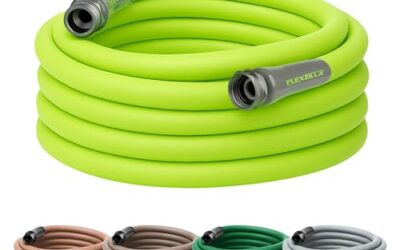
Flexzilla Garden Hose 5/8 in. x 50 ft
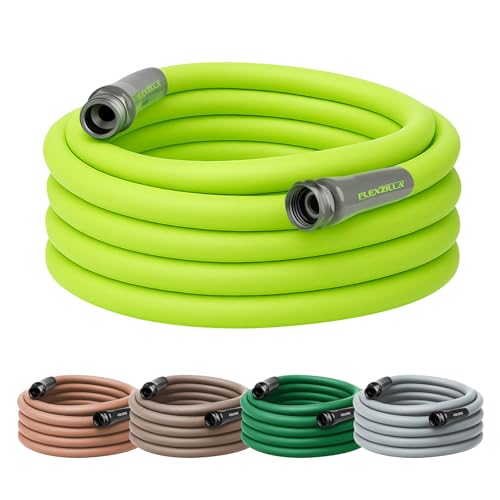
The Flexzilla is the hose most people picture when they picture a modern garden hose: a bright chartreuse hybrid polymer tube that stays bendable when cheaper hoses turn into hoops of stiff plastic. The hybrid polymer wall has no coil memory, so it lays flat instead of fighting you, and it is rated for use from 35 degrees up to 150 degrees Fahrenheit, which covers early spring and late autumn watering in most regions.
At 50 feet and 5/8 inch, this is the all-purpose size: long enough for a typical yard, wide enough to run a sprinkler at the end without the spray pattern collapsing. The anodised aluminium fittings keep weight down and the connections are designed to seal without tools. If you want one hose that simply works for beds, lawn, car washing and patio rinsing, this is the default recommendation.
Specs
- Length 50 ft; bore 5/8 in.; hybrid polymer construction; maximum pressure 150 PSI; temperature rating 35 to 150 degrees F; anodised aluminium fittings; colour chartreuse; model HFZG550YW-E
Best for: Most households that want one hose for every job
Watch out for: The light colour shows dirt and algae marks quickly, and the aluminium fittings should not be left threaded onto brass taps all winter, since dissimilar metals can seize over a long damp season
zero-G 4001-50 (5/8 in. x 50 ft)

The zero-G takes a different route to the same job. Instead of a solid polymer wall, it pairs a flexible Tru-Flex inner core with a woven high-density fabric outer jacket, the same construction idea as a fire hose scaled down for the garden. The result is a 50-foot, 5/8-inch hose that weighs a fraction of an equivalent rubber hose and packs flat on a reel or hook.
That lightness changes who can garden comfortably: anyone with limited grip strength, anyone carrying the hose up steps, and anyone coiling it after every use will feel the difference daily. The trade is care. A fabric jacket shrugs off abrasion on soil and decking but should be drained and stored out of constant summer sun, and it should not be driven over. Aluminium couplings keep the ends light to match the body.
Specs
- Length 50 ft; bore 5/8 in.; Tru-Flex inner core with woven fabric outer jacket; aluminium couplings; colour black; model 4001-50; assembled in the USA
Best for: Anyone tired of dragging a heavy hose, and smaller yards where the hose is coiled after every use
Watch out for: The fabric jacket is not the right choice for dragging across sharp gravel or leaving pressurised in full sun for weeks; store it shaded and drained
Giraffe Tools Garden Hose 50 ft

Giraffe Tools built its name on hose reels, and this standalone hose applies the same hybrid polymer recipe: a 5/8-inch, 50-foot hose that stays flexible, resists deformation under pressure, and arrives with one feature the others here lack, a shut-off valve at the outlet end. That valve lets you swap nozzles, wands and sprinklers without walking back to the tap or wearing the spray while you change tools.
The hose is black with male and female fittings at each end, and the hybrid polymer wall keeps it noticeably lighter than rubber while holding its round shape when the water is on. For gardeners who move between a wand, a sprinkler and a foam cannon in one session, the valve alone justifies the pick; for everyone else it is a well-made mid-weight hose with tidy handling.
Specs
- Length 50 ft; bore 5/8 in.; hybrid polymer construction; built-in shut-off valve; male and female fittings; colour black; model FM-50FT-V
Best for: Watering routines that swap attachments often, and anyone who wants tap control at the working end of the hose
Watch out for: The shut-off valve is a convenience, not a pressure regulator; close the tap itself when you finish, rather than leaving the hose pressurised against the valve
Dramm ColorStorm Premium Rubber Hose 50 ft

The ColorStorm is the old-school answer: a proper EPDM rubber hose, made in the USA, with crush-proof nickel-plated brass couplings that can survive being stepped on and driven over in ways that end aluminium fittings. Rubber stays flexible in cold weather, tolerates hot water from a tap, and shrugs off the dragging, twisting and sun exposure that age polymer hoses.
You pay for that durability in weight. A 50-foot rubber hose is a serious coil to carry, and it will mark light decking if dragged carelessly. In return you get the hose most likely to still be in service a decade from now, in a yellow finish that stays visible in grass and against soil, which matters more than it sounds when the mower comes out. Gardeners who are hard on equipment, and anyone buying once for a large yard, should look here first.
Specs
- Length 50 ft; bore 5/8 in.; EPDM rubber construction; crush-proof nickel-plated brass couplings; colour yellow; made in the USA
Best for: Hard use, hot climates, large yards and anyone who wants the longest service life
Watch out for: It is the heaviest hose in this guide by a wide margin, and the rubber can leave dark scuffs on pale paving if dragged under load
Water Right Polyurethane Garden Hose 75 ft

The Water Right exists for the jobs where what comes out of the hose matters as much as how far it reaches. Its polyurethane body is rated drinking water safe and is free of lead, BPA and phthalates, which makes it the sensible pick for filling RV tanks, topping up animal water, rinsing produce beds you eat from daily, and any hose that children will drink from in summer, as children always do.
At 75 feet it is also the longest hose here, yet polyurethane keeps the coil slim and light for its length, and the material stays flexible in cold weather. The eggplant finish is distinctive, the fittings are lead-free brass, and the burst rating of 300 PSI gives it working margin well beyond household pressure. It costs more per foot than the polymer hoses, which is why it is a specialist pick rather than the default.
Specs
- Length 75 ft; bore 5/8 in.; polyurethane construction; drinking water safe, free of lead, BPA and phthalates; burst pressure 300 PSI; lead-free brass fittings; colour eggplant; model PSH3-075-EP; made in the USA
Best for: Filling drinking water containers, RVs and animal bowls, and long runs where a light coil matters
Watch out for: The slim polyurethane wall kinks more readily than rubber if you yank it around a sharp corner; walk it out rather than pulling from the far end
Which One Fits
- Choose the Flexzilla if you want the single best all-rounder: light, flexible, cold-tolerant and fairly priced by the foot.
- Choose the zero-G 4001-50 if weight is your main complaint with hoses and you coil and store the hose after each use.
- Choose the Giraffe Tools hose if you swap nozzles and sprinklers mid-session and want a shut-off valve at the working end.
- Choose the Dramm ColorStorm if the hose will live outdoors, get dragged over rough ground, and needs to last for many seasons.
- Choose the Water Right if the hose will carry drinking water for people, animals or an RV, or you need 75 feet without a heavy coil.
Common Mistakes
Buying by length alone. A 100-foot hose on a small yard spends its life kinked in a pile, and every extra foot adds weight you drag on every use. Measure the longest run, add a little slack, and stop there.
Leaving any hose pressurised in the sun. A closed nozzle plus summer heat raises internal pressure far above what the tap delivered. That is how bursts happen at the fitting. Shut the tap off and drain the hose after watering.
Storing a hose in a tangled heap. Coil memory is trained, not born. Loop the hose in large even coils on a reel or wall hook and it will unroll straight for years; wad it into a corner and it will fight you forever.
Ignoring the fittings. Most leaks blamed on hoses are worn washers or bent couplings. A fresh rubber washer costs almost nothing, and crush-proof couplings are worth choosing at purchase if the hose crosses a driveway.
FAQ
What length of garden hose do most homes need?
Fifty feet covers the typical suburban yard from one tap, including routing around beds. Measure to your farthest watering point and add slack; only step up to 75 or 100 feet if the measurement demands it, because length adds weight and coiling effort every day.
Are rubber hoses better than hybrid polymer hoses?
They are better at different things. Rubber wins on service life, hot-water tolerance and abuse resistance, and loses heavily on weight. Hybrid polymer wins on handling, cold-weather flexibility and everyday ease. Match the material to how the hose will actually live.
Can I drink from a garden hose?
Only from one rated drinking water safe, like the polyurethane Water Right in this guide. Standard vinyl and rubber hoses can contain plasticisers and metals you do not want in drinking water, and any hose left full in the sun grows warm and stale regardless of material. Flush before drinking.
How do I stop a new hose from kinking?
Lay it out straight in the sun for an hour before first use so the wall relaxes, coil it in large loops for storage, and avoid sharp bends at the tap by adding a strain-relief spring or a short leader hose. Fabric-jacket and polymer hoses kink least once they are trained this way.
Final Verdict
For most yards, the Flexzilla is the hose to buy: flexible in all seasons, light enough for daily use, and built around fittings that seal properly. The zero-G is the comfort pick for anyone who coils their hose constantly, the Giraffe adds a genuinely useful shut-off valve, the Dramm ColorStorm is the buy-it-for-a-decade rubber option, and the Water Right is the one to trust with drinking water. Choose by material and weight first, and the rest of the decision makes itself.