Our Short List of 3
All 5 Picks at a Glance
| Product | Specs | Action |
|---|---|---|
 1. Renogy Pro RBT12100LFP-BT | Check price on Amazon | |
 2. Renogy Core Mini DuoHeat | Check price on Amazon | |
 3. LiTime Group 24 Bluetooth | Check price on Amazon | |
 4. Redodo Group 24 | Check price on Amazon | |
 5. Mighty Max ML100-12 | Check price on Amazon |
Key takeaways
- Best battery setup for RV: five 100Ah house batteries for the living quarters, four LiFePO4 and one AGM, with Bluetooth, self-heating, and live Amazon listings.
Disclosure: As an Amazon Associate, this site may earn from qualifying purchases made through links on this page.
Intro
When RV owners talk about a battery setup, they usually mean one thing: the house battery bank that powers the living quarters. That is the bank that runs the lights, the water pump, the vent fan, the fridge controls, and the phone chargers while the rig is parked. It is separate from the engine battery that turns over the motor. The engine battery needs a short, hard burst of current. The house bank needs steady energy for hours, night after night, and it must survive being drawn down and recharged hundreds of times.
This article treats the setup as the house bank itself. Every pick below is a 100-amp-hour, 12-volt battery that can serve as the core of that bank, and every one has a live Amazon US listing checked during research. Four of the five are lithium iron phosphate, known as LiFePO4, and one is a sealed AGM lead-acid unit for a drop-in replacement. The math is simple: one 100-amp-hour battery at 12.8 volts holds about 1,280 watt-hours of energy. A lithium battery gives you nearly all of that energy, because it can run down to almost empty without damage. An AGM battery of the same size gives you about half, because drawing a lead-acid battery below half charge shortens its life sharply. That difference is the single biggest reason lithium has taken over RV house banks.
A setup is more than one battery: two wired in parallel give you 200 amp-hours, and the bank still needs an inverter, a charger matched to the chemistry, fuses, and cables sized for the load. This article covers the batteries themselves, because they are the heart of the setup. The later sections explain how to size the bank and which pick fits your rig.
At a Glance
| Battery | Chemistry | Capacity | Cycles | Weight | Standout Feature | Best For |
|---|---|---|---|---|---|---|
| Renogy Pro RBT12100LFP-BT | LiFePO4 | 100 Ah | 5,000+ | 26.9 lb | Self-heating and Bluetooth | Cold-weather camping |
| Renogy Core Mini DuoHeat | LiFePO4 | 100 Ah | 5,000+ | 21.4 lb | Compact Group 22NF case | Small compartments |
| LiTime Group 24 Bluetooth | LiFePO4 | 100 Ah | 4,000+ | 22.2 lb | Bluetooth monitoring | Phone-based monitoring |
| Redodo Group 24 | LiFePO4 | 100 Ah | 4,000+ | 21.6 lb | Straight Group 24 swap | Simple replacement |
| Mighty Max ML100-12 | AGM | 100 Ah | Lead-acid | 61 lb | No charger changes | Drop-in AGM replacement |
How to Choose
Size the bank from your daily use, not from the catalog. Add up what the living quarters draw in a day: LED lights and phone charging are small. A vent fan running all night draws more, and a 12-volt compressor fridge is the biggest draw in most rigs, often 40 to 60 amp-hours a day. One 100-amp-hour lithium battery covers a light day of use with margin. Two in parallel cover a fridge, a fan, lights, and charging with room for a cloudy day. An AGM bank needs to be roughly twice as large as a lithium bank for the same usable energy, because only about half of an AGM battery’s rated capacity is usable day to day.
Pick the chemistry first, then the battery. Lithium iron phosphate is the better house-bank chemistry for most RV owners: it gives nearly its full rated capacity, it weighs about a third of an equivalent AGM bank, it charges faster, and it lasts thousands of cycles instead of hundreds. The trade is that lithium needs a charger with a lithium charging profile, and it cannot be charged below freezing without protection. AGM is the simpler swap: it works with the converter and charger your RV already has and tolerates cold charging, but it is heavier and shorter-lived. If your RV has a modern converter with a lithium setting, lithium is the better buy. If your converter is old, AGM is the safer path.
Check low-temperature protection before you camp in the cold. A lithium battery charged below freezing can suffer permanent cell damage. Three of the lithium picks here solve that problem in the battery itself: the Renogy Pro and the Renogy Core Mini both heat themselves before accepting a charge, and the LiTime shuts off charging when the cells are too cold. That protection is what makes lithium usable for shoulder-season and winter camping, and a single cold night at a mountain campground can catch out a battery without it.
Match the group size to the compartment. RV battery compartments were built around lead-acid group sizes, and Group 24 is the common one. The LiTime and the Redodo are both Group 24 cases, so they drop into the compartment a lead-acid Group 24 came out of. The Renogy Core Mini is a Group 22NF case, smaller in every direction, which suits tight compartments where a Group 24 will not fit. The Renogy Pro is a full-size case. Measure the compartment and lid clearance before you order, because a battery half an inch too tall will not let the lid close.
Read the BMS limit, not just the amp-hours. Every lithium battery here has a built-in battery management system, and the continuous discharge limit on that system sets the real limit on what the bank can run. All four lithium picks here carry a 100-amp BMS, which means one battery can feed a 1,000-watt inverter at full load. Two in parallel can feed twice that. If you plan to run a microwave or an air conditioner through an inverter, size the bank to match the inverter.
Wire parallel banks with identical batteries. If you buy two batteries for the bank, buy the same model, from the same maker, at the same time. Mixing different models, ages, or chemistries leads to uneven charging, where one battery works harder and wears out first. Keep the cables between the two batteries the same length, and connect the load across the bank so current flows evenly through both units.
Remember what else the setup needs. The batteries are the heart of the setup, but they are not the whole setup. A full house bank also needs an inverter for AC power, a charger matched to the chemistry, a fuse on the positive cable close to the battery, and cables sized for the inverter’s current. None of those parts are picked here, because the batteries are the decision that matters most. Budget for them anyway, and do not skip the fuse: a shorted lithium bank can deliver enormous current.
The Picks
1. Renogy Pro RBT12100LFP-BT
Renogy 12V 100Ah Bluetooth Self-Heating Lithium LiFePO4 Deep Cycle Battery, Pro Series
The Renogy Pro is the most complete house battery in this group, and it is the pick to buy first if you camp in cold weather. It is a 12.8-volt, 100-amp-hour lithium battery holding about 1,280 watt-hours, with a 100-amp battery management system, built-in Bluetooth, and a self-heating function that warms the cells before charging in freezing weather. The Bluetooth shows state of charge, voltage, and temperature from a phone, and the heater lets the battery keep charging on a cold morning instead of shutting down. The case is sealed to IP67, dust-tight and able to survive a dunk in shallow water, and the maker rates it for more than 5,000 deep cycles with a 7-year warranty, the longest coverage in this group. At 26.9 pounds it is the heaviest lithium pick here, but still less than half the weight of the AGM pick. Buy this one if you camp in shoulder season or winter and you want the battery to look after itself when the temperature drops.
2. Renogy Core Mini DuoHeat
Renogy 12V 100Ah Self Heating Lithium LiFePO4 Battery, Group 22NF, DuoHeat Tech
The Renogy Core Mini solves a different problem: space. It packs the same 100 amp-hours and 1,280 watt-hours as the Pro into a Group 22NF case that measures 9.02 by 5.43 by 8 inches and weighs just 21.4 pounds, the lowest-weight battery in this group. That small footprint suits tongue boxes and under-seat compartments where a Group 24 case will not fit. It still carries a 100-amp battery management system, a self-heating function with dual heating pads that warm the cells faster than a single pad, and a life of more than 5,000 deep cycles with a 5-year warranty. The case is sealed to IP65 against rain and splashes. There is no Bluetooth on this one, so you will want a separate battery monitor if you like watching the state of charge. Buy this one if your compartment is tight and you need full capacity in a small case.
3. LiTime Group 24 Bluetooth
LiTime 12V 100Ah Group 24 LiFePO4 Lithium Battery for RV Solar Van Marine, Bluetooth
The LiTime is the pick for owners who want to watch their battery from a phone. It is a single-pack 12.8-volt, 100-amp-hour Group 24 lithium battery with Bluetooth 5.0, a 100-amp battery management system, low-temperature charging protection, and a life of more than 4,000 deep cycles with a 5-year warranty. The case measures 10.24 by 6.61 by 8.27 inches, the standard Group 24 footprint, so it drops into the compartment a lead-acid Group 24 came out of. At 22.2 pounds it is easy to carry and install by hand. The Bluetooth app shows voltage, current, state of charge, and temperature, so you always know how much energy is left. The maker is clear that this battery is not for cranking an engine: it is a house battery, and it belongs in the living-quarters bank. Buy this one if you want phone-based monitoring in a standard Group 24 case.
4. Redodo Group 24
Redodo 12V 100Ah LiFePO4 Battery Group 24 Lithium Battery, Built-in 100A BMS
The Redodo is the straightforward pick: a 12-volt, 100-amp-hour Group 24 lithium battery with a built-in 100-amp battery management system, a life of more than 4,000 deep cycles, and a 5-year warranty, at 21.6 pounds. There is no Bluetooth and no self-heating here, which keeps the design simple: a Group 24 case that fits the standard compartment, a full 100 amp-hours of usable energy, and a BMS that guards the cells against overcharge, over-discharge, and short circuits. One note on the listing: the title figure of 20.48 kilowatt-hours describes a bank of sixteen batteries wired together, not a single battery. One battery holds about 1,280 watt-hours, the same as every other 100-amp-hour 12-volt battery in this group. Buy this one if you want a simple Group 24 lithium swap and you already have a battery monitor or do not need one.
5. Mighty Max ML100-12
Mighty Max Battery ML100-12 12 Volt 100 AH, Internal Thread Terminal, Rechargeable SLA AGM Battery
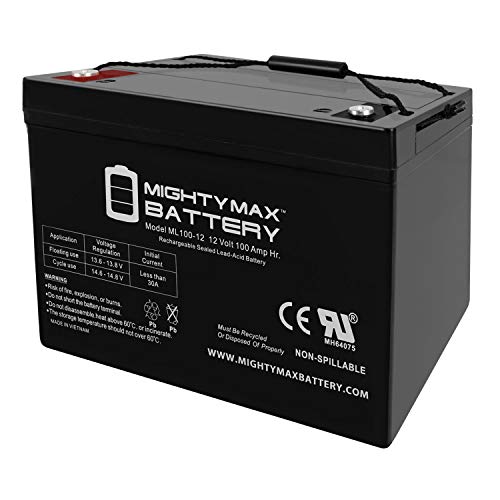
The Mighty Max ML100-12 is the one AGM battery in this group, and it is here for owners who do not want to change anything else in the RV. It is a 12-volt, 100-amp-hour sealed AGM battery with internal-thread terminals and a 1-year warranty. Because it is AGM, it works with the converter and charger your RV already has and needs no new charging profile. The trade is weight and usable energy: at 61 pounds it is nearly three times as heavy as the lithium picks, and only about half of its rated capacity is usable day to day, so a single ML100-12 gives you roughly 50 usable amp-hours where a lithium battery gives you close to 100. One caution: the listing shows two different weight figures, 28 pounds in one spot and 61 pounds in another. This article uses the heavier figure, and you should plan around it until the maker clarifies the listing. Buy this one if you want a drop-in AGM replacement and you are not ready to change the charger.
Comparison Table
| Battery | Chemistry | Capacity | Usable Energy | Cycles | Weight | Warranty |
|---|---|---|---|---|---|---|
| Renogy Pro RBT12100LFP-BT | LiFePO4 | 100 Ah | About 1,280 Wh | 5,000+ | 26.9 lb | 7-year |
| Renogy Core Mini DuoHeat | LiFePO4 | 100 Ah | About 1,280 Wh | 5,000+ | 21.4 lb | 5-year |
| LiTime Group 24 Bluetooth | LiFePO4 | 100 Ah | About 1,280 Wh | 4,000+ | 22.2 lb | 5-year |
| Redodo Group 24 | LiFePO4 | 100 Ah | About 1,280 Wh | 4,000+ | 21.6 lb | 5-year |
| Mighty Max ML100-12 | AGM | 100 Ah | About 640 Wh | Lead-acid | 61 lb | 1-year |
Which One Fits Your Situation
Weekend camper, mild weather, standard compartment. Take the LiTime Group 24 Bluetooth or the Redodo Group 24. Both are standard Group 24 cases that drop into the existing compartment and give a full 100 usable amp-hours, and the choice comes down to Bluetooth monitoring. If you like checking the state of charge from a phone, take the LiTime. If you already have a monitor, take the Redodo.
Cold-weather or shoulder-season camping. Take the Renogy Pro. Its self-heating function is the feature that matters here, because it lets the battery accept a charge on a freezing morning when an unheated lithium battery would refuse. The Bluetooth monitoring, 7-year warranty, and IP67 sealing are the rest of the argument.
Small trailer, tight compartment, or tongue box. Take the Renogy Core Mini DuoHeat. The Group 22NF case is the smallest in this group by a clear margin, and it still holds a full 100 amp-hours with self-heating and a 5,000-cycle life. Measure the compartment first.
Long stays off-grid. Buy two of the same lithium battery and wire them in parallel. A single 100-amp-hour battery covers a light day, but a compressor fridge, a vent fan, lights, and device charging will eat through it in a day and a half. Two matched batteries give you the margin for a cloudy day. Keep the pair identical: same model, same maker, bought at the same time.
Older RV, original converter, no plans to change the charger. Take the Mighty Max ML100-12. It is the only pick here that works with the charging system your RV already has, and it needs no new settings. Accept the weight and the shorter life as the trade for a simple swap, and plan on two of them if you need the usable energy of a single lithium battery.
FAQ
How many amp-hours does an RV house bank need?
It depends on the loads: lights and phone charging need very little, while a vent fan and a 12-volt compressor fridge together often draw 40 to 60 amp-hours a day. One 100-amp-hour lithium battery covers that for a day with margin, and two cover two days or a fridge-heavy setup. An AGM bank needs roughly twice the rated capacity for the same usable energy, because only about half of an AGM battery is usable day to day.
Can I mix lithium and AGM batteries in one bank?
No. Lithium and AGM batteries need different charging voltages and profiles, so a charger set up for one will mistreat the other. Keep one chemistry in a bank, and check that your converter has a lithium setting before you switch.
Do I need a new charger for a lithium house battery?
A charger with a lithium profile is needed for a full charge. Many older converters charge to a lower voltage that leaves a lithium battery partly charged, which wastes capacity. Many modern converters have a lithium setting you can switch on. Check the converter manual before you buy.
Can a lithium RV battery charge below freezing?
Only with protection: an unprotected lithium battery charged below freezing can suffer permanent cell damage. The Renogy Pro and the Renogy Core Mini heat themselves before accepting a charge, and the LiTime shuts off charging when the cells are too cold. The Redodo has no low-temperature protection listed, so it needs warm-weather use. AGM batteries do not have this restriction.
What group size fits my RV?
Measure the compartment. Group 24 is the common RV house battery size, and the LiTime and Redodo picks here are both Group 24 cases. Group 22NF is smaller and suits tight compartments. Check length, width, height, and lid clearance before ordering.
What else does the setup need besides batteries?
An inverter for AC power, a charger or converter matched to the battery chemistry, a fuse or breaker on the positive cable close to the battery, and cables sized for the current the inverter can draw. The batteries are the heart of the setup, but the fuse is the safety device that matters most: a shorted lithium bank can deliver enormous current.
Final Take
For most RV owners, the best battery setup is a lithium house bank built around a 100-amp-hour Group 24 battery, and the LiTime Group 24 Bluetooth is the pick to buy first: standard size, full usable capacity, phone monitoring, and low-temperature protection. If you camp in the cold, step up to the Renogy Pro for self-heating and the longest warranty in the group. If your compartment is tight, the Renogy Core Mini DuoHeat packs the same capacity into a Group 22NF case. If you want the simplest swap, the Redodo Group 24 does the job with no extras. And if your RV still has its original converter, the Mighty Max ML100-12 AGM battery drops in with no charger changes. Whichever chemistry you choose, size the bank from your daily loads, keep a pair matched if you buy two, and do not skip the fuse.