Key takeaways
- Four verified HVLP paint sprayers compared by turbine power, nozzle and air cap sets, hose length, cup style and the coatings each one suits.
Disclosure: As an Amazon Associate, we earn from qualifying purchases.
Our top pick: Wagner Spraytech FLEXiO 5000 Stationary HVLP Paint & Stain Sprayer. Runner-up: Fuji Spray 2202 Semi-PRO 2 HVLP Spray System.
HVLP stands for high volume, low pressure: a large volume of air at low pressure carries paint onto a surface in a soft, controlled fan. Compared with high-pressure spraying, an HVLP gun lays down material with less bounce-back and less overspray drifting around the room, which is why this format is the usual choice for cabinets, furniture, doors, trim and other work where the finish matters more than raw speed. All four sprayers in this guide are turbine-driven HVLP units, checked against real Amazon US listings with verified ASINs. No airless models have been mixed in, because an airless sprayer is a different tool built for a different kind of job.
The four models share the same basic layout: a turbine sits on the floor or a bench and feeds air through a hose to a separate spray gun, so the motor weight never hangs off your wrist. They differ in turbine power, maximum pressure, the nozzles and air caps they ship with, and how much adjustment they give you over material flow, air power and spray pattern. One sprays most unthinned latex straight from the can, one is a workshop system with a long hose and a fine-finish air cap, one is a compact stationary unit with modest pressure figures, and one is a light floor-standing station with a larger fluid tip.
Quick Picks
- Wagner Spraytech FLEXiO 5000 — Best all-round pick: stationary X-Boost turbine base, sprays most unthinned latex, and ships with both an iSpray Nozzle and a Detail Finish Nozzle.
- Fuji Spray 2202 Semi-PRO 2 — Best for fine finish work: 1400 watt two-stage motor, non-bleed gun with a Fan Control Knob, 1.3mm air cap set and a 25 ft hose.
- Wagner Spraytech Control Spray Max — Best compact stationary option: 510 W corded turbine rated at 80 CFM and 2.7 PSI, with a separate spray gun.
- Earlex HV5500 HVLP Spray Station — Best for thicker coatings: 650W two-stage turbine, 2.0mm stainless needle and fluid tip, and a one quart PTFE-coated container.
Wagner Spraytech FLEXiO 5000 Stationary HVLP Paint & Stain Sprayer

OUR TOP PICK
The FLEXiO 5000 is the most versatile sprayer in this guide, and the one to look at first if the work ranges from room walls and fences to furniture and cabinets. It is a stationary design: the X-Boost turbine sits in a base unit on the floor, and only the gun travels in your hand. That split matters over a long session, because the motor weight stays on the ground while you guide a comparatively light gun across the work.
The headline claim on the listing is that the FLEXiO 5000 sprays most unthinned latex. Anyone who has spent time thinning paint in small batches and checking viscosity between coats will understand the appeal: latex is the coating most home projects use, and a sprayer that handles it without thinning removes the fiddliest step in the process, while widening the range of jobs one machine can cover, from emulsion on walls to paint on outdoor furniture.
The second reason it leads this guide is the nozzle pairing. The box includes two nozzles: the iSpray Nozzle, the broader-coverage option for larger surfaces, and the Detail Finish Nozzle, for smaller pieces where a finer finish counts. Swapping nozzles is how this machine moves between a fence panel and a chair without asking one setup to do both jobs badly. The listing also describes complete adjustability across material flow, air power and spray pattern, so the output can be dialled in for the coating in the cup rather than accepted as it comes.
Specs
– Model: 0529091
– Format: Stationary HVLP with X-Boost turbine base
– Coatings: Sprays most unthinned latex, as stated on the listing
– Nozzles included: iSpray Nozzle and Detail Finish Nozzle
– Adjustment: Material flow, air power and spray pattern
Pros
– Sprays most unthinned latex, which removes the thinning step on the most common home coating
– Two nozzles included, one for broad coverage and one for detail finishing
– Stationary turbine base keeps motor weight off the gun hand
– Material flow, air power and spray pattern are all adjustable
Cons
– A stationary base and hose take up more room than a single handheld unit
– Buyers who only ever spray fine finishes may not need the broad-coverage nozzle
Fuji Spray 2202 Semi-PRO 2 HVLP Spray System

The Semi-PRO 2 is the workshop-leaning system in this guide, and the runner-up for anyone whose spraying leans toward fine finishes on furniture, cabinetry and trim. At its heart is a 1400 watt two-stage bypass motor housed in a metal turbine case, with a gun holder on the case so the gun has somewhere to live between coats. Two-stage turbines are the format to look for when a sprayer will be asked to atomise finer finishes consistently, and the metal case suits a machine that will be moved around a workshop rather than kept in a cupboard.
The gun is an M-Model non-bleed spray gun fitted with a Fan Control Knob, which adjusts the pattern from a small circular shape out to a wide fan. That range lets one gun handle both a narrow chair rail and a cabinet door. The installed air cap set is 1.3mm, a size aimed at finer finishes, and the gun feeds from a 1 quart bottom-feed cup.
Reach is the other strength here. The system includes a 25 ft hose with an air control valve, the longest hose in this guide, so the turbine can stay in one place while you work around a large piece or move along a run of cabinets. Maximum pressure is 5 PSI, the highest figure recorded in this guide, and the whole system weighs 25 pounds. It runs on a North American 120V plug only, and it carries a 24 months parts and labor warranty. One caution from the listing copy checked for this guide: availability on this model can change, so confirm the listing is live before planning a project around it.
Specs
– Motor: 1400 watt two-stage bypass motor in a metal turbine case
– Gun: M-Model non-bleed spray gun with Fan Control Knob
– Air cap set: 1.3mm installed; 1 quart bottom-feed cup
– Hose: 25 ft, with air control valve
– Maximum pressure: 5 PSI
– Weight: 25 pounds
– Power: North American 120V plug only
– Warranty: 24 months parts and labor
Pros
– Two-stage 1400 watt motor in a metal case, with a gun holder on the case
– Fan Control Knob takes the pattern from a small circle to a wide fan
– 25 ft hose is the longest in this guide, with an air control valve
– 1.3mm air cap set suits finer finish work
Cons
– At 25 pounds it is the heaviest system here, so it suits a fixed workshop spot
– North American 120V plug only, so it is not a travel-anywhere unit
– Bottom-feed cup is a single format; there is no second cup style in the box
Wagner Spraytech Control Spray Max Corded HVLP Paint Sprayer

The Control Spray Max is the second Wagner in this guide, and it takes the same stationary idea as the FLEXiO 5000 in a smaller, simpler form. The turbine unit sits separately and feeds a separate spray gun, so the working layout is the familiar floor unit plus hose plus gun, with the motor weight kept off your arm. For a first HVLP sprayer, that format is forgiving: the gun is light to guide, and the turbine can sit wherever the cord reaches.
Its recorded figures are modest and worth reading plainly. The unit is corded and rated at 120 VAC and 510 W, with 80 CFM of air volume and 2.7 PSI of pressure. Set against the Fuji system above, the pressure figure is roughly half, which places the Control Spray Max toward the lighter end of HVLP work: thinner materials, smaller pieces, and household painting jobs where a soft, controlled fan matters more than pushing heavy coatings. The 80 CFM figure is the reminder that HVLP is about air volume rather than pressure, and a turbine rated this way is designed to move plenty of air gently.
What the listing does not record matters too. No nozzle sizes, hose length or cup capacity were captured from the listing checked for this guide, so this is not the pick for a buyer who wants to match a specific air cap to a specific coating from the spec sheet alone. What it gives you instead is a straightforward stationary HVLP from an established sprayer maker, sized for general household work rather than demanding finish schedules. If your spraying is occasional — a set of doors, a dresser, a run of fence panels with thinned paint — this is the level of machine that fits.
Specs
– Model: 0518080
– Format: Corded stationary HVLP turbine unit with separate spray gun
– Power: 120 VAC, 510 W
– Air volume: 80 CFM
– Pressure: 2.7 PSI
Pros
– Stationary turbine keeps the gun light in the hand
– 80 CFM air volume suits the soft, low-pressure fan HVLP is built around
– Simple, established format for general household spraying
Cons
– 2.7 PSI is the lowest maximum pressure recorded in this guide
– No nozzle sizes, hose length or cup capacity were recorded from the listing
– Corded only, so the turbine must stay within reach of an outlet
Earlex HV5500 HVLP Spray Station
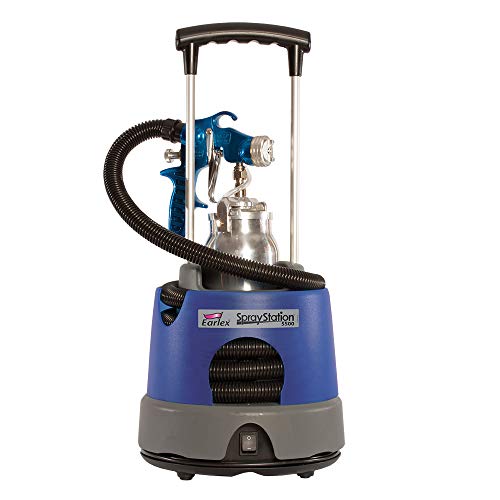
The Earlex HV5500 is a floor-standing spray station built around a 650W two-stage turbine, and its specification reads differently from the other three: where the Fuji leans toward fine finishes with a 1.3mm cap, the Earlex ships with a 2.0mm stainless needle and fluid tip. Tip size is the clearest signal of what a spray gun is set up to spray, and a 2.0mm tip is the larger opening in this guide, suiting thicker materials that would struggle through a finer setup. The container is a 1.05-quart, roughly one quart, PTFE-coated vessel, and a coated container is easier to clean after sticky coatings.
Pattern changing on the Earlex is handled with a push-and-click mechanism that switches between the three spray patterns — horizontal, vertical and round — and there is a variable material flow control to match output to the coating in the container. The air hose is 13 ft, which is about half the reach of the Fuji system, so the station will need to move with you around larger work. At 12.17 lb it is by far the lightest complete station in this guide, and moving it is correspondingly easy. The recorded warranty is two years.
A clear note on verification: this model was confirmed through secondary sources that track the Amazon listing rather than through a direct copy of the listing itself, and one source marked it as currently unavailable. Treat the link as a starting point and confirm the listing is live and selling before relying on it; if it is not, the three sprayers above are all verified directly and cover the same ground between them.
Specs
– Turbine: 650W two-stage turbine, floor-standing spray station
– Needle and fluid tip: 2.0mm stainless
– Container: 1.05-quart (1 qt) PTFE-coated
– Hose: 13 ft air hose
– Spray patterns: Horizontal, vertical and round, push-and-click change
– Controls: Variable material flow control
– Weight: 12.17 lb
– Warranty: 2 years
Pros
– 2.0mm stainless tip is the largest in this guide, suiting thicker coatings
– Lightest station here at 12.17 lb, so it is easy to reposition
– PTFE-coated container is easier to clean after use
– Three spray patterns with a simple push-and-click change
Cons
– 13 ft hose is the shortest reach in this guide
– Verification rests on secondary sources, so the live listing needs confirming
– One tip size only; finer finish work would want a smaller setup
How to Choose
Begin with the coating, because it decides more than anything else. Latex and other thicker materials need a sprayer set up for them: the FLEXiO 5000 states that it sprays most unthinned latex, and the Earlex pairs a 2.0mm tip with a two-stage turbine. Finer finishes — the lacquers, stains and clear coats used on furniture and cabinetry — reward a smaller air cap and a controllable fan, which is the Fuji system’s ground with its 1.3mm cap set and Fan Control Knob. If your work sits in the middle, with thinned paints on household pieces, the Control Spray Max covers it with a simpler setup.
Next, look at the turbine. A two-stage motor, as fitted to the Fuji and the Earlex, is the format to choose for consistent atomisation across a session; wattage gives a rough sense of capacity, from the 510 W of the Control Spray Max through the 650W of the Earlex to the 1400 watt Fuji. Maximum pressure tells a related story: 5 PSI on the Fuji, 2.7 PSI on the Control Spray Max. Read these numbers as a guide to how heavy a coating the system is built to push, not as a score to maximise.
Then consider reach and weight together. A 25 ft hose lets the turbine stay put while you circle a workpiece; a 13 ft hose means the station travels with you, which is painless when the station weighs 12.17 lb and more of a chore when the system weighs 25 pounds. Think about where the turbine will live during a job, and how far the gun needs to roam from it.
After that, check the controls. Adjustable material flow appears across this guide, and the FLEXiO 5000 adds adjustment for air power and spray pattern as well. Pattern adjustment matters: matching a horizontal fan to a tall panel and a vertical fan to a wide one keeps coats even and reduces wasted material, while a round pattern suits spindles, rails and other narrow parts.
Finally, weigh the practical details: cup and container size decide how often you stop to refill, with one quart containers on both the Fuji and the Earlex, and warranty length differs, with 24 months on the Fuji and two years on the Earlex.
FAQs
Can an HVLP sprayer spray latex without thinning it?
It depends on the sprayer and its tip setup. The FLEXiO 5000 in this guide states on its listing that it sprays most unthinned latex, which is exactly the capability to look for if latex is your main coating. With other sprayers, the air cap or needle size decides what will pass: a larger tip, such as the 2.0mm set on the Earlex, handles thicker material more readily than a fine 1.3mm cap, which is intended for thinner finishes. When in doubt, expect to thin, and test on scrap before the workpiece.
What is the difference between a stationary turbine sprayer and a handheld one?
In a stationary system, the turbine sits on the floor or bench and feeds air through a hose to a separate gun, so your hand carries only the gun and its cup. All four sprayers in this guide follow that layout. The advantages are a lighter gun, less fatigue over a long session and room for a bigger motor in the base unit. The trade-off is the hose: its length sets how far you can roam, from 13 ft on the Earlex to 25 ft on the Fuji.
Which of these sprayers suits fine furniture and cabinet finishes?
The Fuji Semi-PRO 2 is the natural pick for that work: its 1.3mm air cap set is a fine-finish size, its non-bleed gun gives a Fan Control Knob that runs from a small circular pattern to a wide fan, and its two-stage motor is built for consistent atomisation. The FLEXiO 5000 is the other candidate, because its Detail Finish Nozzle exists for exactly this kind of smaller, finish-led work, while its second nozzle keeps larger painting jobs in reach.
Conclusion
For most buyers, the Wagner FLEXiO 5000 is the place to begin: it sprays most unthinned latex, includes nozzles for broad coverage and detail finishing, and adjusts across material flow, air power and spray pattern, from a stationary base that keeps the gun light. The Fuji Semi-PRO 2 is the runner-up and the better choice for finish-led workshop work, with its two-stage motor, 1.3mm cap set, fan control and 25 ft hose. The Wagner Control Spray Max covers lighter household spraying in a simpler stationary format, and the Earlex HV5500 suits thicker coatings with its 2.0mm stainless tip in the lightest station here — subject to confirming its listing is live. Match the sprayer to your main coating, check hose length against your workspace, and the right choice usually makes itself.