Key takeaways
- Two braided stainless steel washing machine hoses that fit LG washers: 5 ft and 6 ft pairs with 90-degree elbows, 3/4-inch fittings and color-coded lines.
The hoses behind an LG washer are the cheapest part in the laundry room and the one most likely to flood it. Rubber supply lines age, swell and split, often without warning, and a burst hose can release a full flow of water while nobody is home. Replacing them with braided stainless steel lines is a small job with a large payoff, but the choice still matters: the wrong length pulls tight or loops behind the machine, and a straight fitting in a tight alcove kinks where an elbow would turn cleanly.
This guide is for LG washer owners replacing worn supply hoses, buyers setting up a new machine, and anyone moving a washer into a tight laundry closet. Both hoses below were chosen from the name and specifications on the Amazon product page, and each one uses the standard 3/4-inch hose-thread fittings that LG washers take, so either pair connects to the washer inlets and the wall valves without an adapter.
Quick Picks
As an Amazon Associate we earn from qualifying purchases
| Product | Best for | Key spec from title |
|---|---|---|
| Eastman 5 ft Washing Machine Hose Connectors with Elbows | A washer pushed close to the wall | 5 ft pair, 3/4 in FHT x 3/4 in FHT, braided stainless steel |
| Puxyblue 6 ft Stainless Steel Washer Hose with 90 Degree Elbow | Valves set farther from the washer | 6 ft pair, 90 degree elbow, 304 stainless steel braid |
How to Choose
Measure the run before you pick a length
Washing machine hoses come in 4, 5 and 6 foot lengths, and the right one is the length of the actual route from each wall valve to its washer inlet, plus a gentle curve. A hose that is too short pulls tight at the fittings and can work loose over time, while one that is too long loops behind the machine, rubs against the wall and can kink. Pull the washer into its normal position, measure both routes with a tape, and buy the shortest length that reaches with slack to spare. A 5 foot pair suits most laundry rooms, while 6 feet helps when the valves sit farther away or you pull the machine out for service.
Match the fitting and decide on elbows
Nearly every United States washer and supply faucet uses a 3/4-inch connection, and LG washers are no exception: their inlets take standard 3/4-inch female hose thread fittings. Both pairs in this guide use 3/4-inch fittings on both ends, so they thread onto the washer and the valves the same way. The second decision is the fitting shape. A 90-degree elbow turns the corner right at the machine, which lets a washer sit flush against the wall without bending the hose sharply. A straight end is fine when there is open space behind the machine, but in a tight alcove the elbow is the safer shape.
Read the braid, the core and the rating
A braided stainless steel exterior over a flexible inner tube is the standard upgrade from plain rubber, because the steel mesh holds the inner tube together under pressure. Under the braid, look for the core material: Eastman uses a PVC core with braided nylon reinforcement and a clear vinyl shell, while Puxyblue uses an EPDM rubber core. The burst rating is the pressure the hose is built to withstand, and the pairs here are rated at 1,200 and 1,500 psi. Certification marks add a second check: the Eastman pair is UPC approved and CSA certified, which means it was tested against published plumbing and safety standards rather than a maker claim alone.
Plan the hot and cold lines and the replacement cycle
Every washer needs two supply lines, one hot and one cold, and mixing them up is an easy mistake to make behind a machine you cannot see. Color coding solves it: red for hot and blue for cold, with one hose of each color in the pair. Check that the washers or gaskets inside the couplings are included and in good shape, because the gasket is the real seal at each joint. Hoses are also a wear item, not a fit-and-forget part. Inspect them for bulges, cracks or dampness at the fittings, and replace the pair on a regular cycle even if they still look fine from the front.
The 2 Best Options
Eastman 5 ft Washing Machine Hose Connectors with Elbows

The Eastman pair is the steady, certified choice for an LG washer that sits close to the wall. At 5 feet it covers the usual valve-to-washer distance without a long loop of slack behind the machine, and the 90-degree elbows at the ends let the hoses turn into the corner instead of bending sharply. The braid is grade 304 stainless steel over a PVC core with nylon reinforcement, and the pair carries UPC approval and CSA certification, which is the deepest compliance stack in this guide. Blue and red color coding keeps the hot and cold lines straight during installation.
Specs
- Two 5 ft hoses with 3/4 in FHT x 3/4 in FHT connections
- Braided stainless steel exterior, grade 304
- PVC core with multi-filament braided nylon reinforcement and clear vinyl outer shell
- 90-degree elbows on each hose for tight spaces
- Blue hose for cold water and red hose for hot water
- Nickel-plated brass nuts with stainless steel ferrules
- UPC approved and CSA certified for residential use
- Maximum pressure 1,500 psi; working temperature 15°F to 158°F
- Washers included
Best for: An LG washer pushed close to the wall where elbows and a mid-length pair keep the lines tidy.
Watch out for: The 5 foot length may fall short if the valves sit far from the washer, so measure both routes before ordering; the elbows may not suit every installation layout.
Puxyblue 6 ft Stainless Steel Washer Hose with 90 Degree Elbow
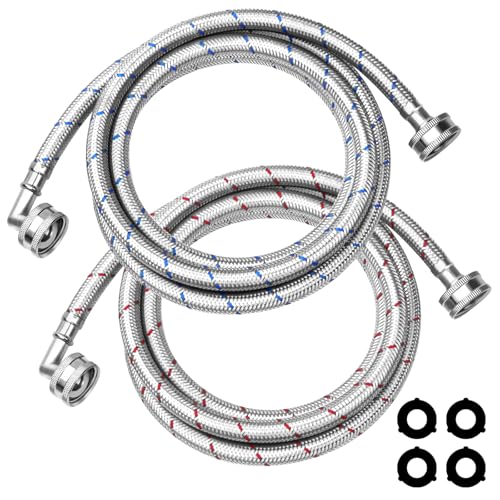
The Puxyblue pair is the reach-first pick, with 6 feet per hose for laundry rooms where the valves sit farther from the washer or the machine gets pulled forward for service. The build is a 304 stainless steel braid over an EPDM rubber core, with brass nuts and ferrules at the couplings and a 90-degree elbow that turns the corner behind the machine. Red and blue color coding marks the hot and cold lines, and the listing names a 10-year warranty. The 3/4-inch female hose connection fits the standard inlets on LG washers and the usual wall valves.
Specs
- Two 6 ft hoses, 2-pack for hot and cold water supply
- 304 stainless steel braided exterior over an EPDM rubber core
- 90-degree elbow on each hose
- 3/4-inch female hose connection on both ends
- Red hose for hot water and blue hose for cold water
- Brass nut and ferrule at each coupling
- Extra-thick rubber washers and sealing gaskets included
- 10-year warranty stated on the listing
Best for: An LG washer whose valves sit farther away, or a setup where the machine moves out for service.
Watch out for: Six feet can leave slack to manage behind a close-set washer, so route the extra length in a smooth curve rather than a tight coil; confirm the elbow orientation suits the valve positions before fitting.
Which One Fits Your Situation
Your washer sits tight against the wall
Pick the Eastman 5 ft pair. The 90-degree elbows turn the corner right at the machine, so the washer can sit flush without the hoses bending sharply, and 5 feet is enough for most valve positions without a loop of slack. The UPC approval and CSA certification add a tested standard behind the braid, which matters for a part you will not look at again for years.
Your valves are farther from the washer
Pick the Puxyblue 6 ft pair. The extra foot per hose covers a wider gap and gives room to pull the machine forward for service without disconnecting anything. Keep the slack in a smooth curve behind the washer rather than coiling it tight, and check that the elbows point the right way for the valve positions before tightening.
You want the most tested, code-listed pair
Pick the Eastman 5 ft pair. Its UPC approval and CSA certification mean outside bodies tested it against published plumbing and safety standards, and its 1,500 psi maximum pressure is the highest figure in this guide. That combination suits a buyer who wants the strongest paper trail behind a part that guards against flooding.
You want the longest reach with the longest stated warranty
Pick the Puxyblue 6 ft pair. It gives the most routing room of the two and the listing states a 10-year warranty, the longest backing here. The 304 stainless braid over an EPDM core and the thick included gaskets make it the pick for a buyer who values reach and a long warranty over a certification stack.
Common Mistakes
- Buying a length without measuring: a hose that is too short pulls at the fittings, and one that is too long loops and kinks behind the machine.
- Reusing the old washers or gaskets: the gasket is the seal, and a flattened or cracked one leaks even on a brand-new hose.
- Overtightening with a wrench: hand-tighten the coupling, then add only a small turn, because too much force can crack the fitting or crush the washer.
- Swapping the hot and cold lines: check the red and blue coding at both ends before running a load.
- Confusing a supply hose with a drain hose: supply hoses bring water in under pressure, while the drain hose carries wastewater out, and the two are not interchangeable.
Frequently Asked Questions
Do these hoses fit all LG washers?
Yes, in the usual case. LG washers take standard 3/4-inch hose-thread inlets, and both pairs here use 3/4-inch female hose thread fittings on both ends, so they thread onto the washer inlets and the wall valves without an adapter. Check the inlet size in your model’s manual before ordering if the washer is an unusual or older variant.
How often should washing machine hoses be replaced?
Inspect the hoses at least once a year for bulges, cracks, fraying braid or dampness around the fittings, and replace the pair on a regular cycle even when they look fine. Rubber lines age from the inside, and a hose that looks sound from the front can still fail, so a scheduled replacement is cheaper than a flooded laundry room.
Do I need hoses with elbows?
Elbows help when the washer sits close to the wall or in a tight alcove, because the 90-degree bend turns the corner at the machine instead of forcing the hose into a sharp kink. Straight ends work fine when there is open space behind the washer. Either way, the hose should curve gently with no tight bends at the fittings.
Can I install washing machine hoses myself?
Yes, with basic tools. Shut off both wall valves and unplug the washer, unscrew the old hoses, fit the new washers into the couplings, and hand-tighten the new hoses onto the washer inlets and the valves. Turn the water back on slowly, check every joint for drips, and call a plumber if a valve is stuck, corroded or will not shut off fully.