Key takeaways
- Find the best sprayers for weed killer for spot treatments and large lawns. Compare manual, battery-powered, and hose-end models before you buy.
A good weed killer is only half the job. The other half is getting it onto the weeds evenly, in the right concentration, and without soaking the plants you want to keep. That is exactly what the best sprayers for weed killer are built to do: they turn a jug of concentrate or a ready-to-use formula into a controlled, even application, whether you are spot-treating a few dandelions along a driveway or covering a half-acre lawn.
Disclosure: As an Amazon Associate, we earn from qualifying purchases made through links on this page, at no extra cost to you.
Quick Picks
| Sprayer | Best For | Tank | Type |
|---|---|---|---|
| Chapin 20004 SureSpray | Most homeowners | 1 gallon | Manual pump |
| PetraTools HD101 | Longer reach and fan coverage | 1 gallon | Manual pump |
| PetraTools HD2000-S | No pumping, steady pressure | 2 gallons | Battery powered |
| Ortho Dial N Spray | Fast, tank-free applications | No tank | Hose-end |
| Smith Performance Sprayers R200 | Large properties and frequent use | 2 gallons | Manual compression |
If you want one recommendation and nothing else, start with the Chapin 20004 SureSpray. Its one-gallon tank is light enough to carry comfortably, its translucent body shows the liquid level at a glance, and its adjustable nozzle handles both pinpoint spot treatments and wider passes. If your lawn is larger or your arm tires easily, the battery-powered PetraTools HD2000-S removes pumping from the job entirely.
1. Chapin 20004 SureSpray 1-Gallon Pump Sprayer

The Chapin 20004 SureSpray is the classic one-gallon hand-pump sprayer, and it earns the top spot here because it does the basics so well. Its translucent polyethylene tank holds one gallon of mixed weed killer, and the funnel-top opening makes refills and mixing mess-free. A built-in filter in the tank helps keep debris away from the nozzle, which matters when mixing concentrates outdoors.
It ships with a 34-inch hose and a 12-inch wand, with enough reach to treat weeds along fence lines and under shrubs without crouching over every plant. The adjustable cone nozzle switches between a fine mist for delicate areas and a direct stream for weeds growing in driveway cracks or along patio edges. An auto and manual pressure relief valve lets you release pressure safely before opening the tank.
Buyer feedback reported in reviews praises the clog-resistant nozzle and the see-through tank, which prevents running dry halfway along a fence line. The most common complaint is pressure retention: some owners report that the pump loses pressure over time or needs frequent re-pumping. The hose can also kink if stored coiled too tightly, so hang it loosely.
Key specs: 1-gallon translucent polyethylene tank; funnel-top opening with in-tank filter; 34-inch hose; 12-inch wand; adjustable cone nozzle; auto/manual pressure relief valve; compatible with herbicides, fertilizers, and pesticides.
Best for: Most homeowners spot-treating weeds and covering small to medium lawns.
Verification note (25 November 2026): Amazon listing ASIN B000E28UQU — UNABLE TO VERIFY. The Amazon page could not be opened directly (access restricted, HTTP 403); this ASIN rests only on a third-party review listing, which is weaker evidence. Check current price and availability on Amazon before buying.
2. PetraTools HD101 1-Gallon Pump Sprayer

The PetraTools HD101 is the pick for anyone who found the Chapin 20004 slightly short on reach. Its headline feature is a 52-inch hose, noticeably longer than the 34-inch hose on most one-gallon competitors, which lets you treat weeds along fence lines and into raised beds without dragging the tank behind you. It also ships with two separate nozzles, a flat fan and a concentrated stream, so you can switch spray patterns without fiddling with an adjustment ring mid-job.
The one-gallon tank is made from HDPE with chemical-resistant seals and clear volume markings, which help with accurate mixing when you are diluting a weed killer concentrate. A built-in ergonomic carry handle makes the unit comfortable to transport, and the whole sprayer weighs approximately three pounds empty, so a full tank stays manageable.
Buyer feedback reported in reviews highlights the comfortable handle and the practical difference the longer hose makes on real yards. Owners also note that replacement parts are easy to find, which can extend the sprayer well beyond a single season. On the downside, some users report that the pump loses pressure after extended use and needs occasional re-pumping. The nozzle threading is proprietary, so third-party replacements may not fit, and the sprayer can feel unbalanced when carried by the handle alone at maximum fill.
For weed killer work, the dual-nozzle setup is genuinely useful: the flat fan nozzle gives even coverage across a patch of lawn weeds, and the stream nozzle targets a single dandelion growing between pavers.
Key specs: 1-gallon HDPE tank with chemical-resistant seals; 52-inch hose; two included nozzles (flat fan and stream); built-in ergonomic carry handle; approximately 3 lbs empty; clear volume markings.
Best for: Homeowners who want longer reach and two spray patterns in a one-gallon pump sprayer.
Verification note (25 November 2026): Amazon listing ASIN B0CKRSTX76 — UNABLE TO VERIFY. The Amazon page could not be opened directly (access restricted, HTTP 403); this ASIN rests only on a third-party review listing, which is weaker evidence. Check current price and availability on Amazon before buying.
3. PetraTools HD2000-S Battery Powered Sprayer, 2 Gallon
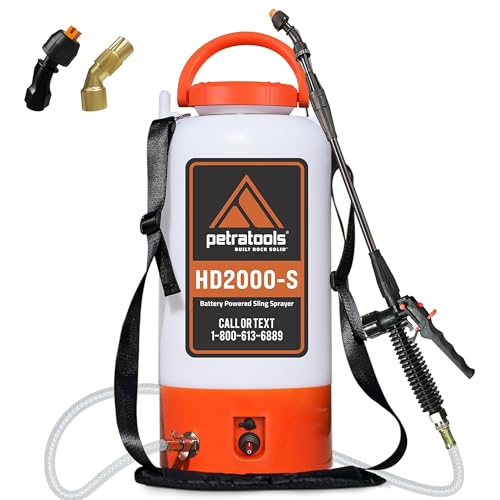
If manual pumping is the part of weed control you dread, the PetraTools HD2000-S removes it entirely. This battery-powered sprayer pressurizes its two-gallon tank electrically, so the spray pattern stays consistent from the first weed to the last, with no gradual pressure drop as the tank empties. The battery and charger are included, and the unit ships with two nozzles covering flat fan and stream patterns.
The two-gallon capacity is the other big advantage. It doubles the coverage of a one-gallon model between refills, which matters on properties over half an acre. According to buyer reports, a single fill can cover roughly half an acre for typical weed killer applications, though that depends on how heavily you spray and how dense the weed growth is.
The trade-offs are weight and dependence on charge. The battery adds heft, so a full two-gallon unit is noticeably heavier to carry than a comparable manual sprayer, and very large properties may need a mid-session recharge. Replacement batteries can also be harder to source than the simple seals and gaskets on a manual pump model. For most residential jobs, though, the convenience of steady, pump-free pressure is worth the extra weight, especially if you spray frequently or have a shoulder or wrist that objects to pumping.
Key specs: 2-gallon tank; battery-powered pressurization (battery and charger included); rechargeable lithium-ion battery system; two included nozzles (flat fan and stream); compatible with herbicides, pesticides, fertilizers, and fungicides.
Best for: Larger lawns and frequent sprayers who want consistent pressure without manual pumping.
Verification note (25 November 2026): Amazon listing ASIN B0BKNW96PV — UNABLE TO VERIFY. The Amazon page could not be opened directly (access restricted, HTTP 403); this ASIN rests only on a third-party review listing, which is weaker evidence. Check current price and availability on Amazon before buying.
4. Ortho Dial N Spray Hose-End Sprayer
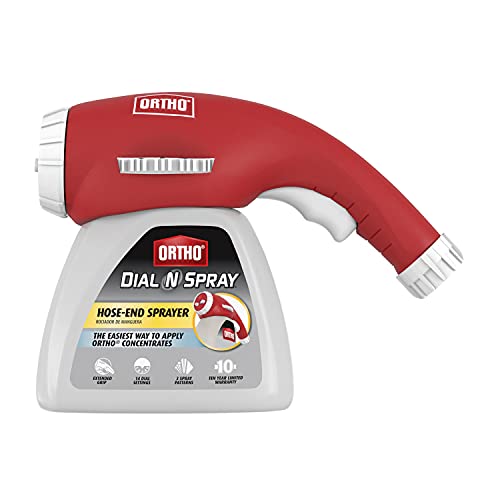
The Ortho Dial N Spray takes a completely different approach: it has no tank and no pump. Instead, it attaches directly to a standard garden hose and uses water pressure to mix concentrate and spray it in one step. A dial with 14 dilution settings lets you select the concentration for different products without measuring or premixing, and a built-in siphon tube draws the concentrate straight from its container.
The caveats are real, though. Spray consistency depends on your home water pressure, so homes on low-pressure well systems may notice uneven mixing. The dilution settings are not always perfectly accurate, and some buyers recommend checking the concentration with a small test batch before a full application. You are also limited by hose length, which restricts reach compared with a self-contained tank sprayer you can carry anywhere.
The Dial N Spray is best understood as a complement to a tank sprayer rather than a replacement for one. Use it for fast, broad applications where precision matters less, and keep a one-gallon pump sprayer for targeted work near flower beds and vegetable gardens, where an overspray mistake is costly.
Key specs: 14 dilution settings; hose-end attachment for standard garden hoses; built-in siphon tube; no tank to fill or pump to operate; compatible with liquid weed killers, insect killers, and fungicides.
Best for: Quick, tank-free weed killer applications on lawns within hose reach.
Verification note (25 November 2026): Amazon listing ASIN B0071D0EZK — UNABLE TO VERIFY. The Amazon page could not be opened directly (access restricted, HTTP 403); this ASIN rests only on a third-party review listing, which is weaker evidence. Check current price and availability on Amazon before buying.
5. Smith Performance Sprayers R200 2-Gallon Compression Sprayer

The Smith Performance Sprayers R200 is the heavy-duty option in this roundup, built for people who apply weed killer often and across larger areas. Its two-gallon tank is made from chemical-resistant polyethylene, and its heavy-duty compression pump is designed to hold pressure longer than the pumps on most consumer models. Reinforced seals and gaskets are rated for harsh herbicides, which matters most if your sprayer sees weekly chemical exposure through a full season.
The professional-grade wand and nozzle assembly gives a steady, controlled spray pattern, and a pressure relief valve allows safe depressurization before you open the tank. The two-gallon capacity reduces refill stops on larger lots, and the compression system maintains steady pressure across the whole tank cycle rather than fading as the liquid level drops.
That build quality comes with weight. The R200 is noticeably heavier than consumer-grade sprayers when full, and the professional nozzle may produce a wider pattern than a small garden bed needs. It also sits in a higher price tier, which may not be justified if you only spray a few times a year. But for a large property or anyone who treats weeds as a weekly routine, the durability is the point: seals that resist chemical degradation and a pump that keeps its pressure are worth paying for when the alternative is replacing a budget sprayer every season.
Key specs: 2-gallon chemical-resistant polyethylene tank; heavy-duty compression pump system; reinforced seals and gaskets rated for harsh herbicides; professional-grade wand and nozzle assembly; pressure relief valve.
Best for: Large properties and frequent users who need commercial-level durability.
Verification note (25 November 2026): Amazon listing ASIN B01AT587J6 — UNABLE TO VERIFY. The Amazon page could not be opened directly (access restricted, HTTP 403); this ASIN rests only on a third-party review listing, which is weaker evidence. Check current price and availability on Amazon before buying.
How to Choose the Best Sprayer for Weed Killer
Match tank size to your property
A one-gallon tank weighs roughly eight to nine pounds when full, which most people can carry comfortably for fifteen to twenty minutes. If your property is under a quarter acre, a one-gallon model handles the job with one or two refills. For properties over half an acre, a two-gallon tank reduces refill stops but adds noticeable weight. If you have a large lawn and a bad back, a battery-powered two-gallon model may be a better answer than a heavier hand-carried tank.
Manual pump vs. battery powered
Manual pump sprayers are lighter, simpler, and have fewer components that can fail. The downside is that pressure gradually drops as the tank empties, so you stop to re-pressurize every few minutes. Battery-powered models maintain consistent pressure throughout the application, but they add the weight of the battery and a dependence on charge level. If you spray frequently, electric pressurization is worth the extra weight. For occasional use, a manual pump keeps things simple and costs less.
Hose-end sprayers: convenience with caveats
Hose-end sprayers like the Ortho Dial N Spray eliminate the tank entirely and let you spray for as long as your hose reaches, with the dilution dial handling mixing automatically. However, spray consistency depends on your home water pressure, and low-pressure systems may produce uneven results. Hose-end models work best for quick applications on smaller areas rather than thorough coverage of large properties, and they are a poor choice near delicate plantings where precise control matters.
Nozzle types and spray patterns
An adjustable cone nozzle switches between a narrow stream for targeted weed treatment and a wider mist for general coverage. Flat fan nozzles produce an even rectangular pattern that is ideal for uniform lawn application. If you plan to use the sprayer for more than one job, a model with interchangeable nozzles gives you more flexibility than a single adjustable tip. For weed killer specifically, a fan nozzle is best for lawn weeds, while a stream or cone nozzle is better for weeds in cracks and along edges.
Chemical compatibility and seal quality
Weed killers are hard on seals and gaskets, and seal failure is the most common reason a sprayer starts leaking. Look for chemical-resistant seals and a tank material rated for herbicides, and check the product label to confirm the sprayer is approved for the chemicals you plan to use. After each session, rinse the tank, hose, and nozzle with clean water, and never store a sprayer full of mixed herbicide.
Dedicate one sprayer to herbicides
University extension services advise against using the same sprayer for weed control and insect control, because herbicides such as 2,4-D are difficult to remove completely and leftover residue can damage the plants you later spray. The practical answer is to own two sprayers: a one-gallon tank marked “herbicide only” and a second sprayer for insecticidal soap, fungicide, or foliar feed. Label the herbicide tank clearly so nobody grabs it for the wrong job.
Safety and application tips
Always read the weed killer label before mixing, wear gloves and eye protection, and spray on a calm day when rain is not expected for at least the period stated on the label. Early morning or late evening applications reduce drift and evaporation, and spraying when weeds are actively growing improves uptake. Keep children and pets off treated areas until the product has dried.
Frequently Asked Questions
What size sprayer do I need for weed killer?
For most suburban lawns under a quarter acre, a one-gallon sprayer is enough, with one or two refills per session. Properties over half an acre are easier with a two-gallon model, and properties over an acre usually call for a backpack sprayer or a hose-end model. Choose the smallest tank that covers your area comfortably, because a full tank is heavy and a half-empty tank still needs carrying.
Can I use the same sprayer for weed killer and fertilizer?
You can, but it is not ideal. Herbicide residue can linger in seals, hoses, and nozzles even after rinsing, and it can damage desirable plants if the sprayer is later used for other chemicals. The safest practice is to dedicate one sprayer to herbicides and use a separate sprayer for fertilizer, insecticide, and fungicide.
Are battery-powered weed killer sprayers worth it?
Yes, if you spray often or over a large area. Battery-powered sprayers maintain steady pressure for the whole tank, which gives more even coverage and removes the physical effort of pumping. They cost more and weigh more than manual models, and you need to keep the battery charged. For occasional spot treatments on a small lawn, a manual pump sprayer is simpler and cheaper.
How do I stop my weed killer sprayer from leaking?
Most leaks come from worn seals, a loose pump assembly, or a cracked hose. Rinse the sprayer after every use, do not over-tighten the pump cap, and store the sprayer out of direct sunlight, which degrades seals and plastic. Replace worn O-rings and gaskets promptly, and check that the nozzle and hose connections are snug before each session. If a tank itself is cracked, replace the sprayer rather than trying to patch it.
How long does mixed weed killer last in a sprayer?
Most manufacturers recommend using mixed weed killer the same day and not storing it in the sprayer. Mixed solutions can lose effectiveness over time and can damage seals if left sitting. Mix only as much as you need for one session, spray it the same day, and rinse the tank, hose, and nozzle with clean water when you finish.
Conclusion
The best sprayers for weed killer match the size of your property and the way you like to work. For most homeowners, the Chapin 20004 SureSpray is the right starting point: a one-gallon manual pump sprayer that is light, simple, and easy to dedicate to herbicide use. If you want longer reach and two spray patterns, step up to the PetraTools HD101. If pumping is the problem, the battery-powered PetraTools HD2000-S keeps pressure steady across a two-gallon tank. For fast, tank-free jobs within hose reach, the Ortho Dial N Spray is the quickest option, and for large properties and frequent use, the Smith R200 brings commercial-grade durability.
Whichever model you choose, dedicate it to weed killer, rinse it after every session, and spray on calm days.