Key takeaways
- Compare washing machine auto shutoff hoses in 5 ft and 6 ft pairs, with leak-triggered safety valves, 90-degree elbows and the specs that matter most.
A washing machine supply hose sits under full water pressure around the clock, including the hours when nobody is home, so the real decision is not simply which hose fits. It is whether a hose that splits or pulls loose will keep running until someone finds the water, or whether a valve inside the hose itself will close and limit the damage. Length, fitting shape and hose construction still matter, yet the shutoff behaviour is what separates this shortlist from ordinary braided replacements.
This guide is for homeowners replacing ageing rubber hoses, landlords protecting a rental laundry, and anyone whose washer stands on a finished floor or above living space. Both picks are Shark Industrial Flood Safe pairs chosen from their Amazon listing names and stated specifications: a reinforced PVC core, a rigid corrugated outer wall, and a built-in auto shut-off valve that reacts when leakage is detected between the inner and outer tubing.
Quick Picks
As an Amazon Associate we earn from qualifying purchases
| Product | Best for | Key spec from title |
|---|---|---|
| Shark Industrial Flood Safe Washing Machine Hoses, 5 FT, Red-Blue | Standard laundry layouts where the taps sit close behind the machine | Built-in auto shut-off valve |
| Shark Industrial Flood Safe Washing Machine Hoses, 6 FT, Red-Blue | Washers that must pull forward for servicing or sit further from the taps | Built-in auto shut-off valve |
How to Choose
How the shutoff valve detects a leak
Begin with the trigger, because not every safety hose reacts to the same failure. The Shark Industrial design used in both picks places a moisture-sensitive safety valve in a double-wall hose: if the inner tube leaks, water reaches the space between the inner and outer tubing, and the valve shuts off the supply. That targets a split or leaking inner hose, the failure most likely to run unnoticed behind a machine. The system is passive and mechanical, needing no power, batteries, sensor pad or phone connection. It cannot help with a leak inside the machine itself, at a drain hose, or at a wall valve, so treat the hose as one layer of protection rather than a flood system.
Hose length and working slack
Measure the route before choosing between the 5 ft and 6 ft pairs here, because a shutoff hose pulled tight is a hose under constant strain. Follow the path the hose will actually take from wall tap to machine inlet, rather than the straight-line gap, then allow extra length so the machine can be pulled forward for cleaning without dragging on the fittings. Too little slack stresses the elbow and valve end whenever the washer vibrates. Too much spare hose is not automatically better, since long loops can rub against the wall or back panel. Pick the shortest length that still lets you slide the machine out calmly, routed without kinks, twists or a levelling foot trapping it.
Construction, core and outer wall
Look past the colour and read how the hose is built, since the valve only helps if the body holds the leak long enough for it to react. Both picks use two layers of reinforced PVC core with nylon braided lines between them, sealed inside a rigid corrugated outer wall. That outer wall is functional, not decorative: it traps water escaping the inner tube and channels it to the safety valve, which is how the valve learns of the failure. A plain single-wall hose, however strong its braid looks, has no such detection path. Check that the hose you consider states its layer construction, and be wary of listings that use flood language while describing an ordinary single tube.
Fittings, elbows and standards
Finish with the ends, because most laundry leaks begin at a connection rather than mid-hose. Both pairs use a standard 3/4 inch 90-degree elbow connection, described on the listings as FHT or FGH fittings, and the elbow lets the hose drop straight down behind the machine instead of looping against the wall. That matters in shallow closets where the washer sits close to the taps. Confirm your taps and machine inlets match that thread before ordering, and use the standards line as a quality screen: these listings cite ASME A112.18.6-2017 and CSA B125.6-17, plus NSF/ANSI 61 and 372. A listing naming no thread size, elbow shape or standards leaves you guessing at details that decide whether the install seals.
The 2 Best Options
Shark Industrial Flood Safe Washing Machine Hoses, 5 FT, Red-Blue
This 5 ft pair suits the typical laundry layout where the taps sit on the wall directly behind the machine and a longer hose would only gather in loose loops. Each hose pairs a red or blue outer wall with the line it feeds, which keeps hot and cold straight during fitting, and the built-in safety valve reacts when leakage is detected between the inner and outer tubing. Because the shutoff is moisture-triggered rather than flow-triggered, normal filling should not trip it, and there is no test mode described on the listing, so correct fitting is the main thing fully in your control.
Specs
- Brand: Shark Industrial
- Length: 5 ft per hose, sold as a 2-pack
- Part number: SHK-AQCB/CR-5GN-025
- Material: Polyvinyl Chloride (PVC)
- Construction: Two layers of reinforced PVC core with nylon braided lines between, sealed with a rigid corrugated outer wall
- Safety feature: Built-in auto shut-off valve, triggered when water leakage is detected between the inner and outer tubing
- Connection: 3/4 inch 90-degree elbow, FHT or FGH fittings
- Colour: Red-blue
- Standards listed: ASME A112.18.6-2017/CSA B125.6-17, NSF/ANSI 61,372
- Warranty listed: 10-year warranty
Best for: Homes with a standard tap-to-machine distance that want leak-triggered shutoff without extra slack behind the washer.
Watch out for: Measure your route first, because 5 ft leaves little spare length if the taps are offset to one side of the machine.
ASIN: B07TBJ21K9
Shark Industrial Flood Safe Washing Machine Hoses, 6 FT, Red-Blue
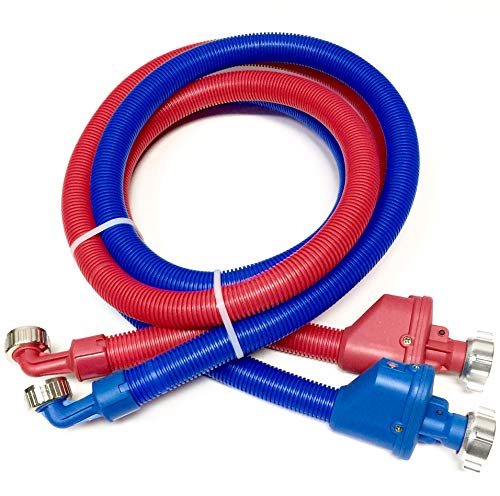
Choose the 6 ft pair when the machine stands further from its taps, when the supply points are offset, or when you regularly pull the washer forward to clean behind it and need the hoses to travel with it. The construction mirrors the shorter set: a reinforced PVC core in two layers, nylon braiding between those layers, and a rigid corrugated outer wall in red-blue that contains an inner leak so the safety valve can shut the supply off. The extra foot of length is the whole point of this version, so judge it on your measured route rather than treating longer as automatically safer for every laundry room.
Specs
- Brand: Shark Industrial
- Length: 6 ft per hose, sold as a 2-pack
- Part number: SHK-AQCB/CR-6GN-027
- Material: Polyvinyl Chloride (PVC)
- Construction: Two layers of reinforced PVC core with nylon braided lines between, covered with a rigid corrugated outer tube
- Safety feature: Built-in safety valve for auto shut off when water leakage is detected between inner and outer tubing
- Connection: 3/4 inch 90-degree elbow, FHT or FGH fittings
- Colour: Red-blue
- Standards listed: ASME A112.18.6-2017/CSA B125.6-17, NSF/ANSI 61,372
- Warranty listed: 10-year warranty
Best for: Offset taps, deeper laundry rooms and machines that get pulled forward for cleaning or servicing.
Watch out for: Route the extra length in a wide, supported curve, because a loose loop left rubbing on the floor or wall works against the hose over time.
ASIN: B07TBHRL5T
Which One Fits Your Situation
Your taps sit right behind the machine
Take the 5 ft pair, ASIN B07TBJ21K9, when the taps are centred behind the washer and the inlets are within reach. A shorter run leaves less hose to coil or hide a kink, and the elbows let each hose turn down neatly in the narrow gap, with the same leak-triggered valve as the longer set. The requirement is honest measurement: if the route plus pull-out slack runs past five feet, step up a size instead of stretching it tight.
You pull the washer out to clean behind it
Pick the 6 ft pair, ASIN B07TBHRL5T, if you move the machine for cleaning or repairs. That extra foot lets the hoses stay connected while the washer slides forward, avoiding repeated disconnection that wears washers and threads. Route both so they fold back in a gentle arc when the machine returns, with no sharp bend at the elbow. Check the run after the first wash, since a hose tidy while dry can shift once the machine vibrates under load.
The laundry is upstairs or above finished rooms
Either pair earns its place, because a supply failure costs more when water can reach ceilings, wiring and rooms below. Choose by measured length, then add habits around the hoses: keep the wall taps accessible, inspect the outer walls whenever you are behind the machine, and replace a hose if its valve has triggered. The valve guards against an inner-tube leak specifically, so a drain pan or floor sensor remains a second layer for leaks inside the machine cabinet.
You are a landlord fitting out a rental laundry
Standardise on one length per property after measuring, and record which pair went in and when. The 5 ft set covers most purpose-built laundry cupboards, while the 6 ft set handles older homes with taps placed for a previous layout. A leak-triggered hose suits rentals because it needs no power, no tenant action and no app account between tenancies. Note the 10-year warranty and part number in your maintenance file so a future claim begins with the right details recorded.
Common Mistakes
- Buying on length alone and ignoring the shutoff type, ending up with a strong braided hose that has no valve and no way to react when its inner tube fails.
- Stretching a 5 ft pair across a route that really needs 6 ft, which leaves the fittings under constant tension and makes every spin cycle tug at the connections.
- Overtightening the elbow fittings with a wrench until the washer inside deforms, when a firm hand-tight seal plus a careful check after the first fill is the safer approach.
- Assuming the valve covers every leak in the room, when it only responds to leakage inside its own hose, not to a failed drain hose, a cracked machine inlet or a dripping wall tap.
- Fitting the new pair and never looking behind the machine again, missing early chafing, a slow weep at a fitting or an outer wall that has been crushed by the machine being pushed back too far.
Frequently Asked Questions
How does an auto shutoff washing machine hose actually work?
In the double-wall design, the inner tube carries water while a rigid outer wall surrounds it. If the inner tube leaks, water collects between the two walls and reaches a moisture-sensitive material at the valve. That material expands and pushes the valve shut, stopping the supply through that hose. It is mechanical, needs no electricity, and reacts only to a leak inside its own hose, not water from elsewhere.
Will the safety valve trip during a normal wash cycle?
The listings describe a shutoff driven by leakage between the inner and outer tubing, not ordinary flow, and note there is no test mode for the function. Normal filling should not trigger it. Problems are likelier when a hose is kinked, stretched or fitted to the wrong thread, so measuring and matching the 3/4 inch elbows to your taps matters more than a setting, since the hose has none.
Can one of these hoses protect against every laundry room flood?
No. These valves respond when the hose’s own inner tube leaks into its outer wall. They do not react to a split drain hose, a fault inside the machine, an overflowing standpipe or a leak at a wall valve before the hose fitting. Treat one as targeted protection against a common, serious failure, then keep the surrounding plumbing maintained too, especially on upper floors where escaping water travels further.
How do I choose between the 5 ft and 6 ft pairs?
Measure the route from tap to inlet, following corners rather than cutting across them, then add slack to pull the machine forward without straining fittings. Inside five feet, the shorter pair keeps things tidy and leaves less hose to rub or kink. If it runs close to that limit, or taps are offset, choose the 6 ft pair and route the spare in a curve clear of floor and panel.