Our Short List of 3
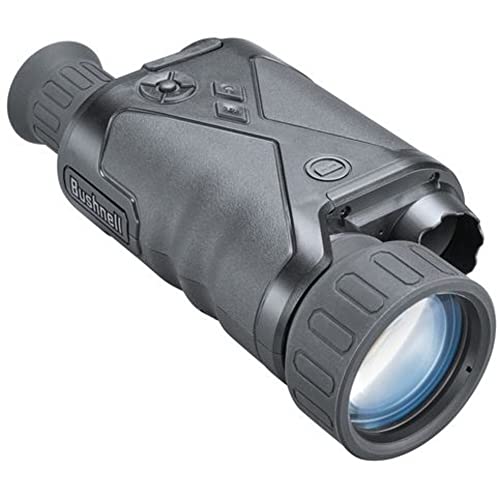
- Best for: stationary long-range watching with recording and phone streaming
- Magnification: 6x optical with 3x digital zoom
- Objective lens diameter: 50mm
- Night viewing: up to 900 feet with the IR illuminator on high
- Recording: 1080p HD video and still photos to a microSD card

- Best for: routine yard, livestock and fence checks with minimal setup
- Magnification: 5x
- Objective lens diameter: 32mm
- IR illuminator range: up to 650 feet
- Recording: photos and video to a microSD card in day and night modes

- Best for: detecting animals or people hidden by brush, fog or darkness itself
- Infrared detector: 160×120
- Display: 720×540 LCOS
- Functions: distance measurement and highest temperature target tracking
- Connectivity: Wi-Fi hotspot
All 4 Picks at a Glance
| Product | Specs | Action |
|---|---|---|
| Bushnell Equinox Z2 6×50 |
| Check price on Amazon |
| Bushnell Equinox X650 |
| Check price on Amazon |
| AGM Asp-Micro TM160 |
| Check price on Amazon |
 GOYOJO GNG2K |
| Check price on Amazon |
Key takeaways
- The best infrared monoculars compared on IR range, sensor resolution, recording and battery life, with picks for fields, yards, fences and helmets.
The real decision is what you need to pick out in the dark: an animal shape standing at a fence line, a person crossing a yard, or a heat signature hidden in brush. Those are three different jobs, and the listings split into two technologies that answer them differently. Digital models pair a light-sensitive sensor with an infrared illuminator, while a thermal monocular reads heat directly and needs no light at all. Choosing the wrong type wastes money faster than choosing the wrong brand.
This guide is for landowners checking property after dark, hunters scouting without a lamp, and campers or wildlife watchers who want to see what moves at night. Each pick below was chosen from the product names and specifications printed on its Amazon listing, with the comparison built around infrared range, sensor or detector resolution, recording ability, and how the unit is powered.
Quick Picks
As an Amazon Associate we earn from qualifying purchases
| Product | Best for | Key spec from title |
|---|---|---|
| Bushnell Equinox Z2 6×50 | Long-range viewing with recording and app streaming | 6x magnification, 50mm objective, 1080p video |
| Bushnell Equinox X650 | Simple yard and livestock checks on AA power | 5x magnification, IR range up to 650 feet |
| AGM Asp-Micro TM160 | Finding heat signatures in brush, fog or smoke | 160×120 infrared detector, 720×540 LCOS display |
| GOYOJO GNG2K | Helmet-mounted movement with a covert illuminator | 2K sensor, 940nm stealth IR, 60Hz refresh |
How to Choose
Decide Between Amplified Light and Heat
Digital infrared monoculars work like a camera: a sensor collects available light, an infrared illuminator adds invisible light in total darkness, and a screen shows the scene. They give you recognizable shapes, faces and antlers, and most record photos or video. A thermal monocular ignores visible light completely and builds its picture from heat differences, so animals stand out in brush, fog or light smoke where a digital unit sees only leaves. The trade-off is detail: thermal shows silhouettes, not fine features. Pick digital for identification and recording, thermal for detection.
Match the Infrared Range and Wavelength to Your Ground
Every range figure on a listing assumes total darkness with the illuminator on its highest setting, so treat it as a ceiling rather than a promise. A unit listed at 650 feet suits yards, feeders and fence lines, while a 900-foot figure serves fields and long driveways, especially on a tripod. Wavelength matters too. Common 850nm illuminators reach farther but can show a faint red glow at the lens, while 940nm light stays covert for wary animals and close observation. Match the listed range to your longest real sight line, not the biggest number on the page.
Check Recording Resolution and the Screen
If you want evidence or clips to look at later, confirm what the listing actually records. One pick here captures 1080p video with sound to a memory card and streams to a phone app, while another records without publishing any sensor resolution at all, which tells you footage is a secondary feature. Screen quality shapes live viewing as much as the sensor: a 60Hz OLED eyepiece keeps the image smooth while you pan or walk, and a small TFT or LCOS panel is fine for stationary watching. Decide whether you are buying a viewer or a camera.
Plan Power Before You Plan Features
Battery arrangements differ more than buyers expect. AA-powered models are easy to feed on a trip if you carry spares, but heavy infrared use drains cells quickly and the batteries are often sold separately. Built-in rechargeable packs run longer per charge and top up over USB, yet they end the session when they die unless the design accepts spare cells. Check three lines on every listing before ordering: the battery type, whether batteries and a memory card are included, and the stated runtime with the infrared light switched on.
The 4 Best Options
Bushnell Equinox Z2 6×50
- Best for: stationary long-range watching with recording and phone streaming
- Magnification: 6x optical with 3x digital zoom
- Objective lens diameter: 50mm
- Night viewing: up to 900 feet with the IR illuminator on high
- Recording: 1080p HD video and still photos to a microSD card
stationary long-range watching with recording and phone streaming
batteries and the microSD card are not included, and at 1.68 pounds it is happier on a tripod than in a jacket pocket
This is the pick for watching one place for a long time: a field edge, a long driveway or a feeder you can cover from a porch or blind. The 6x magnification and 50mm objective pull in more light than smaller units, and the listing credits the illuminator with clear viewing up to 900 feet in night mode on its high setting. Recording and Wi-Fi streaming set it apart, because a tripod-mounted unit can be watched and controlled from a phone instead of an eyepiece.
Bushnell Equinox X650
- Best for: routine yard, livestock and fence checks with minimal setup
- Magnification: 5x
- Objective lens diameter: 32mm
- IR illuminator range: up to 650 feet
- Recording: photos and video to a microSD card in day and night modes
routine yard, livestock and fence checks with minimal setup
Bushnell does not publish the sensor or screen resolution for this model, so judge it on range and simplicity rather than footage detail
The X650 is the straightforward option for people who want to step outside, switch on, and check the yard, the chicken coop or a line of fencing. Its 5x magnification and an illuminator listed at up to 650 feet cover the distances most property checks actually involve, and it records both daytime and nighttime video to a memory card for a quick look later. Three AA batteries keep it simple to feed, and the body stays compact enough for a truck console or a barn shelf.
AGM Asp-Micro TM160
- Best for: detecting animals or people hidden by brush, fog or darkness itself
- Infrared detector: 160×120
- Display: 720×540 LCOS
- Functions: distance measurement and highest temperature target tracking
- Connectivity: Wi-Fi hotspot
detecting animals or people hidden by brush, fog or darkness itself
the listing positions this as a short-range thermal imager, and a 160×120 detector shows shapes rather than fine detail as distance grows
The Asp-Micro answers a different question: not what something looks like, but whether something warm is there at all. Its infrared detector reads heat, so a bedded deer, a raccoon in a tree line or a person in fog shows up as a clear shape even when there is no light for a digital sensor to amplify. The listing builds in distance measurement and a Wi-Fi hotspot, and the housing stays small enough for a coat pocket, which makes it a genuine scanning tool rather than a novelty.
GOYOJO GNG2K
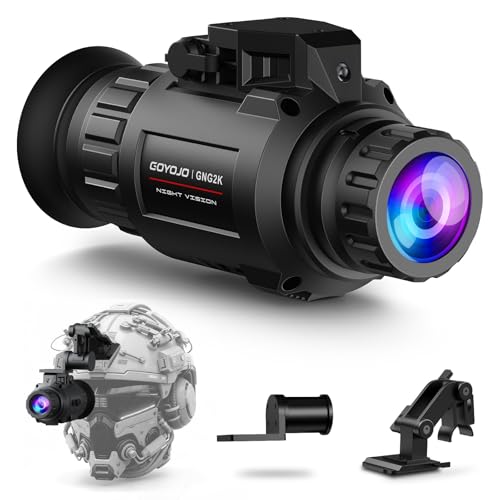
- Best for: hands-free night movement on trails or around rural property
- Sensor resolution: 2688×1520 (2K), sensitive down to 0.0001 lux
- Display: OLED eyepiece with 60Hz refresh
- IR illuminator: 940nm, with 3 brightness levels
- Color modes: 4
hands-free night movement on trails or around rural property
the listing publishes no battery-life figure and no water resistance information, and the base view is 1x, so this is a navigation tool rather than a distance viewer
The GNG2K is built for moving through the dark rather than sitting still in it. The listing describes a 2K sensor behind an OLED eyepiece running at a 60Hz refresh, which keeps the picture steady while you turn your head, and the 940nm illuminator is the covert wavelength that avoids the faint red glow of standard infrared light. It can ride on the included helmet mount for hands-free walking or come off for handheld scanning, and four color modes let you match the display to the terrain.
Which One Fits Your Situation
You Watch One Field or Driveway From a Fixed Spot
Choose the Bushnell Equinox Z2 6×50. Mounted on a tripod, its 6x magnification and 900-foot listed night range cover ground you cannot walk to quietly, and Wi-Fi streaming means the view comes to your phone while the unit stays outside. The 1080p recording also keeps a record of what crossed the property overnight.
You Check Animals and Buildings on Foot Each Evening
Choose the Bushnell Equinox X650. It switches on fast, runs on three AA batteries you can replace anywhere, and its 650-foot listed range matches the distance between a house, a barn and a fence line. Recording to a card covers the odd night when you want to look again at what set the dog off.
You Need to Know Something Is There, Not What It Looks Like
Choose the AGM Asp-Micro TM160. Heat does not hide behind brush or thin fog the way shapes hide from a camera sensor, so a quick scan tells you where animals are bedded before you commit to a stalk or a walk. The built-in battery lasting up to 10 hours covers a full night of intermittent scanning.
You Walk Trails or Timber After Dark
Choose the GOYOJO GNG2K. On its helmet mount your hands stay free for gates, leashes or a walking stick, the 940nm illuminator will not announce you to wildlife, and the 60Hz eyepiece keeps the image readable while you move. The wide 45-degree field of view suits following a path rather than studying one distant point.
Common Mistakes
- Comparing headline range numbers without noticing they assume total darkness and the illuminator on its highest setting.
- Buying a thermal monocular and expecting recognizable faces or license plates, when the technology only shows heat shapes.
- Assuming every infrared light is invisible, when 850nm illuminators can glow faintly red and 940nm is the covert choice.
- Forgetting that batteries and memory cards are often sold separately, so the unit arrives unable to record or even switch on.
- Cranking digital zoom to its maximum and judging the monocular harshly, when zooming a sensor image always softens detail.
Frequently Asked Questions
What is the difference between an infrared monocular and a thermal monocular?
A digital infrared monocular uses a light-sensitive sensor plus an infrared illuminator to show a recognizable picture of the scene, much like a camera. A thermal monocular reads heat instead of light and displays warm objects as bright shapes against cooler backgrounds. Digital units identify and record detail; thermal units detect through brush and fog.
How far can an infrared monocular see at night?
It depends on the illuminator strength, the objective lens size and the setting in use. Listings here quote up to 650 feet and up to 900 feet, both measured in total darkness with infrared on high. Moonlight, haze and ground cover shorten real distances, so treat the printed figure as a best case for your longest sight line.
Can these monoculars be used in daylight?
Yes. Digital models show a normal color image in daylight and switch to infrared viewing as light falls, and thermal units work around the clock because heat contrast exists in sunshine too. Daylight use is handy for scouting a property in the afternoon and returning to the same spots after dark with the same device.
Do infrared monoculars record what they see?
Some do and some only show a live view. In this group, both Bushnell models save photos and video to a microSD card, and the Equinox Z2 also streams to a phone app. The AGM sends its view out over a Wi-Fi hotspot, while the GOYOJO listing centers on live viewing through its OLED eyepiece rather than recording.