Key takeaways
- The best watering wands for hoses, compared by wand length, spray patterns, pivoting heads and thumb valves for hanging baskets, raised beds and borders.
Disclosure: As an Amazon Associate, we may earn from qualifying purchases made through links on this page, at no additional cost to you.
A watering wand is the simplest upgrade you can make to a garden hose: a long tube with a shower-style head on the end and a flow valve at the handle. That extra length changes how you water. Instead of dragging the hose into the bed and bending over every plant, you stand on the path and lay a gentle rain exactly where it belongs — up into hanging baskets, across the back of a deep border, under the foliage of shrubs, and into the far corners of raised beds. Because the head sits well away from your hand, you can water at soil level without soaking your shoes or blasting mulch out of place.
The four wands below cover the main ways gardeners use these tools. There is a multi-pattern aluminum wand for people who want one tool for everything, a single-pattern rain wand for the gentlest possible shower, a telescoping wand that stretches to reach high hooks and deep beds, and a long turret wand with a ratcheting head for aiming water up, down and sideways. Every pick is a true wand — a long shaft, not a short pistol-grip spray gun — and each one threads onto a standard garden hose.
Quick Picks
- Best multi-pattern wand: Dramm RainSelect Rain Wand, 30-Inch — nine spray patterns on an aluminum shaft, with a one-touch thumb valve.
- Best gentle shower: Dramm One Touch Rain Wand, 30-Inch — a fixed rain head and full thumb flow control for seedlings and delicate blooms.
- Best reach: Melnor RelaxGrip 8-Pattern Pivoting-Head Extension Wand — extends from 33 to 48 inches, with a pivoting head and thumb control.
- Best for aiming: Orbit 58674Z Front Trigger Turret Wand — a 36-inch wand with nine patterns and a ratcheting head that angles the spray.
Dramm RainSelect Rain Wand, 30-Inch (ASIN: B01MY05B2E)

The RainSelect is Dramm’s do-everything wand: a 30-inch aluminum shaft topped with a nine-pattern spray head. Turning the head cycles through Shower, Rain, Center, Cone, Angle, Mist, Flat, Fan and Stream, so the same wand that lays a soft shower over a flower bed can switch to Mist for a tray of seedlings or Stream for filling a watering can and rinsing a muddy trowel. The wand measures 30.25 inches long overall and weighs 1.1 pounds, light enough to hold out over a bed for a full watering session without your arm giving up.
Flow is handled by the One Touch thumb valve at the handle — a pinch-style valve you roll with your thumb to start, stop or throttle the water, with no trigger to hold squeezed. The wand is rated for pressures up to 90 PSI and uses a standard 0.625-inch hose thread connection, and the head and body combine aluminum, metal, plastic and rubber components. Dramm assembles its rain wands in the USA and backs this one with a lifetime warranty against defects in materials and workmanship, and the 30-inch version comes in six colors.
Highlights
– Nine patterns cover everything from seedling mist to a rinsing stream
– Thumb valve gives full flow control without squeezing a trigger
– Aluminum build at 1.1 pounds is easy to hold overhead
– Lifetime warranty and replaceable Dramm parts support
Considerations
– The head does not pivot, so aiming straight down into a tall basket means raising the wand higher
– Pattern dial sits at the far end — you change patterns at the head, not from the handle
Dramm One Touch Rain Wand, 30-Inch (ASIN: B0097CCSHA)

Where the RainSelect is about choice, the One Touch Rain Wand is about one pattern done well. Its fixed shower head breaks the flow into a soft, even rain — the kind of watering that soaks a bed without pushing soil away from roots or flattening seedlings. There is no dial to set and nothing to adjust at the head; all control lives at the handle, where the One Touch valve lets your thumb feather the flow from a trickle to full volume and shut it off completely between plants. That makes it a natural fit for greenhouse benches, seed trays and newly planted borders.
The 30-inch shaft is aluminum with a rubber over-mold at the natural wear point on the handle, and the wand measures 30 by 2.5 by 2.5 inches. Like its sibling, it is rated to 90 PSI, assembles in the USA and carries Dramm’s lifetime warranty. This listing is the 30-inch version in green (model 14804); the same wand family also comes in a shorter 16-inch length and several other colors, so check the variant on the product page if color or length matters to you.
Highlights
– Fixed rain head delivers the gentlest shower in this roundup
– One Touch thumb valve meters flow precisely and shuts off fully
– Nothing to adjust at the head — point it and water
– Aluminum shaft with rubber over-mold at the grip
Considerations
– Single pattern only — no jet or stream for cleanup jobs
– Fixed head angle; no pivot for watering straight down from above
Melnor RelaxGrip 8-Pattern Pivoting-Head Extension Wand (ASIN: B09QLD8T6N)
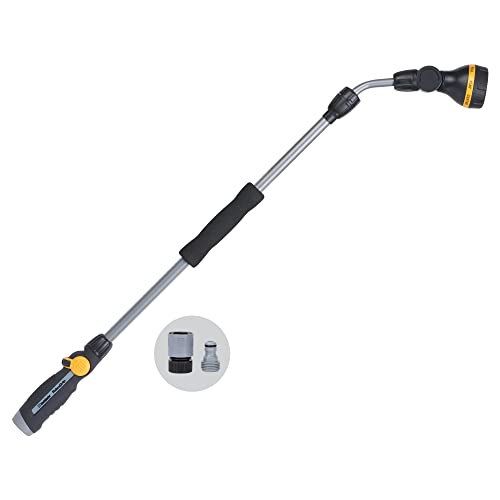
The Melnor RelaxGrip extension wand solves the reach problem by changing size. Its shaft telescopes from 33 inches out to 48 inches, so a wand that handles everyday beds at its shortest setting can stretch to reach baskets hung from porch hooks, tall planters and the far side of a wide raised bed — no step stool and no leaning. At the end of the shaft, the head pivots, letting you angle the spray downward into a basket or upward under a shrub while your hand stays in a natural position. The head carries eight patterns: Shower, Mist, Cone, Flat, Jet, Soaker, Center and Full.
Flow is set with a thumb control on the RelaxGrip handle, a shaped grip designed to reduce strain on the wrist and hand during long watering rounds. The wand is plastic-bodied and weighs about 15.2 ounces, and this bundle (model 65145AMZ) includes Melnor QuickConnect fittings — a product adapter and end connector — so the wand snaps on and off the hose end instead of threading each time. Melnor backs it with a limited two-year warranty.
Highlights
– Telescopes from 33 to 48 inches — the longest reach here
– Pivoting head angles spray into baskets and under shrubs
– Eight patterns, including a soaker setting for deep watering
– QuickConnect fittings included for fast hose-end swaps
Considerations
– Plastic construction is lighter-duty than the aluminum wands here
– QuickConnect system works best if your other hose-end tools use it too
Orbit 58674Z Front Trigger Turret Wand with Ratcheting Head, 36-Inch (ASIN: B004RUFCUC)
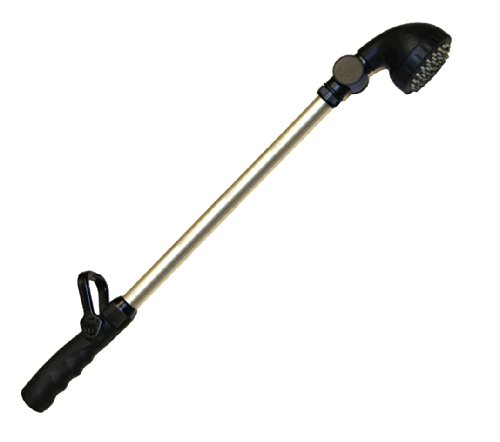
Orbit’s turret wand pairs a fixed 36-inch reach with the most adjustable head in this group. The turret dial selects nine spray patterns — center, cone, fan, shower, angle, flat, flood, mist and jet — and the whole head ratchets, tilting up or down so you can pour water into a hanging basket from below, rain it down on a bed from above, or shoot it sideways under a hedge without twisting your wrist. At 36 inches, it reaches the back of most borders and up to standard basket hooks while you stay on the path.
Flow control is a front trigger with a fireman-style grip lever, a different feel from the thumb valves above: you squeeze to run the water and can modulate the flow with grip pressure, which some gardeners prefer with gloves on. The wand measures 36.75 by 4 by 3.25 inches and combines an aluminum shaft with a plastic turret head and handle. Note that the product name says “10 Pattern” while the listing’s own specification list names nine patterns — the nine-pattern list is the one to go by.
Highlights
– 36-inch fixed reach with a ratcheting head that tilts up or down
– Nine patterns, from flood and soaker-style watering to jet
– Fireman lever is easy to work while wearing gloves
– Aluminum shaft keeps the long wand manageable
Considerations
– Squeeze control can tire the hand on very long watering rounds
– Listing name and pattern count disagree (name says 10, specs list 9)
How to Choose a Watering Wand
Start with length, because it decides what you can reach without bending or stretching. A 30-inch wand is the all-round size: long enough for hanging baskets at head height, raised beds and the middle of a border. Telescoping wands that stretch toward 48 inches earn their keep when baskets hang from high hooks or beds are extra deep, and they collapse back down for storage and close work. Shorter wands in the 14- to 16-inch range behave more like spray guns with a bit of reach — useful at a potting bench, but they give up the stand-back-and-rain advantage that defines a wand.
Next, think about patterns. A fixed rain head is not a limitation if your watering is mostly beds, baskets and containers: a soft shower is what those plants want, and a single-pattern head has nothing to clog or misalign. Multi-pattern turret heads add mist for seedlings, a soaker or flood setting for deep drinks, and a jet for rinsing tools and pots — worth it if the wand is your only hose-end tool. Finally, match the valve to your hands. Thumb valves meter flow precisely and never need holding; trigger and fireman levers are intuitive and glove-friendly but ask your hand to keep working. If you water for long stretches, a thumb valve is usually the kinder choice.
Key Specifications Explained
Wand length is measured along the shaft and sets your working radius. Every extra inch is reach you do not have to supply with your back and shoulders, but very long wands get awkward in tight greenhouse aisles — telescoping models solve that by adjusting.
Spray patterns describe the shape of the water leaving the head. Shower and rain settings spread water into many fine streams that land gently, like rainfall. Mist is finer still, for seedlings and humidity-loving plants. Cone, center and fan settings narrow the spread for targeted watering, while jet and stream concentrate the full flow into one line for rinsing and filling. Soaker and flood settings deliver high volume at low energy, for deep watering at the base of shrubs and trees.
Head articulation comes in two forms: a pivoting head that swings through an arc, and a ratcheting head that clicks into set angles. Both let you aim water downward into baskets or upward under foliage while holding the wand level — the feature that most separates a good wand from a straight tube.
Flow control is the valve at the handle. Thumb valves roll or slide to set flow and hold that setting hands-free. Front triggers and fireman levers vary flow with squeeze pressure and stop when released. Either way, a wand valve that shuts off completely lets you move between plants without dragging a running hose or walking back to the faucet.
Materials and fittings decide lifespan. Aluminum shafts shrug off knocks and sun; plastic wands are lighter and cheaper to replace. All four wands here connect to standard garden hose thread, and working-pressure ratings around 90 PSI comfortably cover household water pressure.
Setup and Use Tips
Thread the wand onto the hose by hand and snug it down — over-tightening with pliers cracks plastic collars and distorts washers. If the joint weeps, the rubber washer inside the coupling is the first thing to check; a fresh washer fixes most wand leaks. With the QuickConnect Melnor, push the adapter onto the hose end once and leave it there, then snap the wand on and off as needed.
Water low and slow. Hold the head a short distance above the soil or basket and let the shower fall like rain; holding it high in the air wastes water to wind and evaporation. For hanging baskets, raise the head to the basket’s rim and water until a little runs from the drainage holes, then move on and come back for a second pass — dry potting mix sheds the first watering. Angle a pivoting or ratcheting head down so water lands on the mix, not the foliage. In beds, work from the back of the border toward yourself so you are never reaching over plants you have already soaked.
When you finish, shut the valve, then release pressure by opening it briefly away from plants before coiling the hose. Storing the wand out of direct sun — in a shed or garage rather than on the fence — slows UV damage to plastic heads and rubber seals.
Common Mistakes to Avoid
The most common mistake is buying on pattern count alone. Ten settings do not water better than one good shower; what matters is whether the patterns you actually use — shower, mist, soaker — are well formed. A close second is choosing a wand that is too short. A compact wand feels handy in the store and then has you bending over every bed, which is the exact problem a wand exists to solve.
Leaving a wand pressurized and baking in the sun all summer shortens its life: seals take a set, plastic heads go brittle, and the valve starts to drip. Drain it and store it in shade. In cold climates, bring wands indoors before the first hard freeze — water trapped in a shower head expands as it freezes and can split the head or shaft. Finally, do not use the jet setting on seedlings, fresh transplants or dry potting mix; a hard stream excavates soil and exposes roots. Start with shower, and save the jet for pots, tools and pavement.
FAQ
What length watering wand is best for hanging baskets?
A 30-inch wand handles baskets hung at or below head height. If your baskets hang from porch beams or high hooks, a telescoping wand that extends to around 48 inches, or a 36-inch wand with a ratcheting head you can angle upward, reaches them without a step stool.
Can a watering wand replace a spray nozzle?
For plant watering, yes — and it is gentler. A multi-pattern wand also covers most nozzle jobs like rinsing tools and filling cans. A compact pistol nozzle is still handier for washing a car or blasting a driveway, where a long shaft just gets in the way.
Do watering wands fit any garden hose?
Yes. Wands use the standard garden hose thread found on household hoses and faucets. Some, like the Melnor above, also include quick-connect fittings; those adapters thread onto the hose once and let the wand snap on and off.
Why does my watering wand leak at the handle?
Usually the washer. The rubber washer inside the hose-end coupling flattens or cracks over time, and the joint starts to weep. Replacing the washer and re-seating the connection hand-tight fixes most leaks; Teflon tape is not needed on hose thread.
How do I keep the shower head from clogging?
Mineral deposits narrow the fine holes in rain heads. Soak the head in a bowl of vinegar solution overnight every few months, then rinse and run water through it. Storing the wand indoors over winter also slows buildup and prevents freeze damage.
Final Verdict
For most gardens, the Dramm RainSelect is the wand to buy first: nine genuinely useful patterns, a fatigue-free thumb valve and an aluminum 30-inch shaft that reaches baskets and beds without bending. If your watering is all about gentleness — seedlings, greenhouse benches, delicate blooms — the Dramm One Touch trades the pattern dial for the softest fixed shower here. Gardeners with high hooks and deep beds should look at the telescoping Melnor RelaxGrip, whose 33-to-48-inch shaft and pivoting head reach what fixed wands cannot, while the Orbit 58674Z suits anyone who wants a long fixed wand with a ratcheting head and a glove-friendly fireman lever. Match the wand to your reach and your valve preference, and the daily watering round gets noticeably easier on your back.