Key takeaways
- Find the best home paint sprayers for walls, fences, cabinets and trim. Compare airless and HVLP picks with real specs to choose the right one.
A brush and roller can carry you through one accent wall, but the moment the job grows to several rooms, a fence line, or a whole exterior, the painting itself stops being the slow part. Prep, masking, and cleanup take over, and a sprayer is what keeps the actual coating step from eating your weekend. The real decision is not whether to spray, but which kind of machine matches the size of your projects and the way you like to work.
This guide is for homeowners tackling their own walls, fences, cabinets, and trim, not for crews running sprayers all day. The five sprayers below were chosen from names and specs on Amazon pages, mixing stand airless units for big surfaces with handheld models for furniture and detail work, so you can match the tool to the job instead of forcing one machine to do everything.
Quick Picks
As an Amazon Associate we earn from qualifying purchases.
| Product | Best for | Key spec from title |
|---|---|---|
| Graco Magnum X5 Airless Paint Sprayer | Whole-house and large exterior jobs | 3000 PSI max pressure |
| Graco Magnum Project Painter Plus | Mid-size rooms and fences on a budget | 2800 PSI max pressure |
| Wagner Control Pro 130 Power Tank | Big jobs with less overspray | 1.5-gallon paint tank |
| HomeRight Super Finish Max | Furniture, cabinets, and trim | 450-watt HVLP turbine |
| Graco TrueCoat 360 VSP | Doors, trim, and detail work | 1500 PSI handheld airless |
How to Choose
Match the sprayer type to the project size
Airless stand units pull paint straight from a bucket and push it through a hose, which makes them the right call for walls, siding, and fences. A handheld HVLP or handheld airless holds its paint in a cup or bag, so it suits a door, a cabinet set, or a piece of furniture, but it turns a whole room into a refill routine. Before you compare features, picture your biggest job: if it is measured in gallons, you want a stand unit with a suction tube, and if it is measured in single pieces, a handheld will be lighter, cheaper, and easier to store.
Check the pressure and flow numbers
Maximum pressure and flow rate tell you what coatings a sprayer can push without thinning. A 3000 PSI airless handles unthinned latex with ease, while a 1500 PSI handheld still manages latex on trim and doors but works harder on thick paint. Flow rate matters just as much: a unit moving 0.27 gallons per minute covers a wall noticeably faster than one moving 0.12, so a slow machine can erase the time you hoped to save. Look for both numbers on the listing, and treat a sprayer that hides them as a warning sign.
Think about the paint supply and refills
Where the paint lives decides how often you stop. A suction tube that drops into a one-gallon can or a five-gallon bucket means you spray until the bucket is empty, which is ideal for fences and exteriors. A cup or FlexLiner bag holds a quart or less, so you refill after every door or two, and you also gain the ability to spray upside down or at odd angles. If your project list is mostly ceilings and high corners, that flexibility may matter more than capacity, but for long flat runs, bucket feeding wins every time.
Weigh cleanup, weight, and storage honestly
Every sprayer needs flushing after use, and the machines that look simplest on the shelf are not always the easiest to clean. A stand airless has a hose, a gun, and a pump to rinse, while a handheld has a cup, a nozzle, and a tip, which is quicker but still fiddly. Weight counts too: a 15-pound stand unit stays on the floor while you move the gun, but a handheld puts every ounce in your wrist. Measure your storage shelf as well, since a cart or tank unit takes real garage space.
The 5 Best Options
Graco Magnum X5 Airless Paint Sprayer

The Magnum X5 is the stand airless most homeowners end up with when the job list keeps growing. Its pump pushes unthinned latex at up to 3000 PSI, and the flexible suction tube draws straight from a one-gallon can or a five-gallon bucket, so there is no cup to refill mid-wall. Graco rates it for projects up to 10 gallons, and it supports up to 75 feet of hose, which reaches second-story peaks without dragging the pump along. At 15 pounds it is not light, but it stays on the floor while you work.
Specs
- Maximum pressure: 3000 PSI
- Maximum flow rate: 0.27 gallons per minute
- Included hose: 25 ft Duraflex hose, supports up to 75 ft
- Spray gun: SG2 metal spray gun with RAC IV 515 SwitchTip
- Paint supply: flexible suction tube for 1 or 5-gallon buckets
- Project size: up to 10 gallons
- Weight: 15 pounds
Best for: Homeowners painting several rooms, a whole exterior, a deck, or a long fence line in one season.
Watch out for: The 15-pound unit plus a full hose takes real floor and shelf space, so confirm you have somewhere dry to store it between projects.
Graco Magnum Project Painter Plus
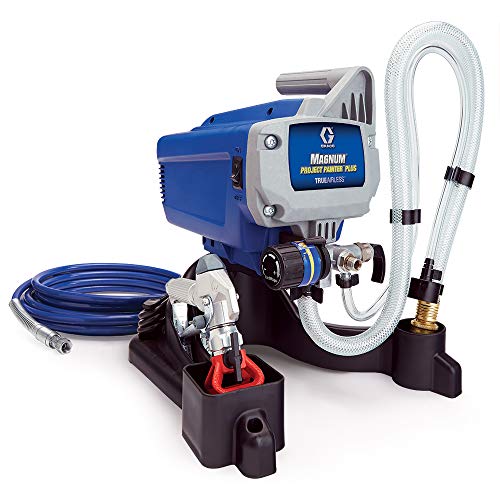
The Project Painter Plus is the smaller sibling of the X5, built for homeowners whose biggest jobs are a few rooms or a fence rather than a whole house. It still sprays unthinned latex, with a maximum working pressure of 2800 PSI and a flow rate of 0.24 gallons per minute, and the suction tube pulls paint directly from a one- or five-gallon bucket. The included 25-foot hose stretches to 50 feet for tall walls, and the whole sprayer weighs about 12 pounds. It is the sensible pick when the X5 feels like more machine than your project list justifies.
Specs
- Maximum working pressure: 2800 PSI
- Maximum flow rate: 0.24 gallons per minute
- Motor: 3/8 HP universal motor
- Included hose: 1/4 in x 25 ft paint hose, supports up to 50 ft
- Maximum tip size: 0.015 in
- Paint supply: flexible suction tube for 1 or 5-gallon buckets
- Recommended annual use: up to 50 gallons
Best for: Homeowners repainting a few rooms, a fence, or a deck each year without paying for the X5’s extra capacity.
Watch out for: The 50-gallon annual rating is a real ceiling, so if you paint far more than that each year, step up to a larger pump.
Wagner Control Pro 130 Power Tank
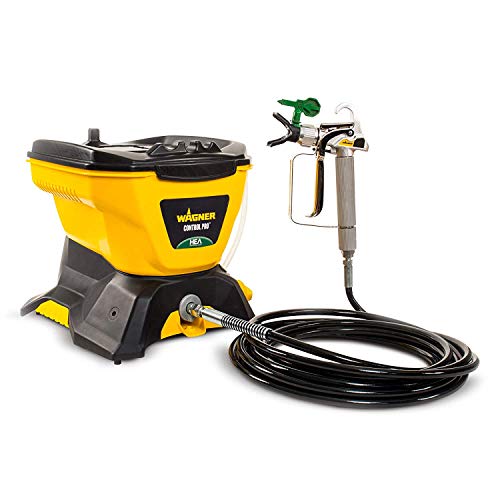
Wagner’s Control Pro 130 takes a different approach to big jobs: instead of a suction tube, it carries a 1.5-gallon tank on the unit, so you pour paint in once and spray large areas without a bucket trailing behind you. Its high-efficiency airless design is built to cut overspray compared with conventional airless spraying, which helps indoors and around landscaping. The kit includes a 515 HEA tip and a 25-foot hose, and the sprayer moves paint at 0.24 gallons per minute with a maximum tip size of 0.015 inches. Graco-style bucket feeding it is not, but for rooms and fences the onboard tank is genuinely convenient.
Specs
- Paint tank: 1.5 gallons
- Included hose: 25 ft hose
- Included tip: 515 HEA spray tip
- Maximum flow rate: 0.24 gallons per minute
- Maximum tip size: 0.015 in
- Recommended annual use: up to 50 gallons
- Weight: 11 pounds
Best for: Homeowners who want a self-contained airless unit for large interior and exterior projects with less overspray to manage.
Watch out for: The 1.5-gallon tank still needs refilling on very large jobs, so keep a spare can nearby for fence and siding work.
HomeRight Super Finish Max

The Super Finish Max is the handheld HVLP pick for people whose project list is mostly furniture, cabinets, doors, and trim. Its 450-watt turbine drives three brass spray tips, and the adjustable nozzle switches between horizontal, vertical, and round patterns, so one tool covers a flat cabinet door and a spindled chair leg alike. It handles stains, sealers, and latex paints, and the whole unit is small enough to live on a shelf. It will not keep up with a whole house, but for the detail work that makes a home look finished, it is the easiest sprayer in this guide to pick up and use.
Specs
- Power: 450-watt turbine
- Spray tips: 3 brass spray tips included
- Spray patterns: 3 patterns, horizontal, vertical, and round
- Sprayer type: HVLP handheld
- Model number: Finish Max C800971
- Suitable coatings: stains, sealers, and latex paints
Best for: DIYers refinishing furniture, kitchen cabinets, interior doors, and trim where control matters more than speed.
Watch out for: Thick latex may need thinning for this HVLP turbine, so test your paint on a scrap board before spraying the real piece.
Graco TrueCoat 360 VSP

The TrueCoat 360 VSP is a handheld airless sprayer for the jobs that sit between a brush and a stand unit: a set of doors, a run of trim, a small fence, or a single room. Its variable speed dial runs from 1 to 10, so you can slow the flow for detail work near ceilings and raise it for open walls. Paint sits in a 32-ounce FlexLiner bag, and the VacuValve system lets the sprayer work in any direction, even upside down, without losing prime. Four spray tips come in the box, two for paint and two for stain, and the stainless steel piston pump reaches 1500 PSI.
Specs
- Maximum pressure: 1500 PSI
- Maximum flow rate: 0.12 gallons per minute
- Speed control: variable, 1 to 10 settings
- Paint supply: 32 oz FlexLiner bags, 4 included
- Spray tips: 4 included, 2 paint tips and 2 stain tips
- Spray direction: any direction, including upside down
- Project size: up to 2 gallons
- Weight: 3.75 pounds
Best for: Homeowners spraying doors, trim, cabinets, and small rooms who want airless power in one hand.
Watch out for: The 32-ounce FlexLiner bags are consumables, so buy a spare pack before starting a multi-door project.
Which One Fits Your Situation
You are repainting several rooms or a whole exterior
Pick the Graco Magnum X5. Its 3000 PSI pump and bucket feeding let you move through walls without stopping to refill, and the 75-foot hose support reaches high peaks. The Project Painter Plus costs less, but the X5’s larger project rating and stronger flow pay off once the job passes a few gallons.
Your biggest jobs are a fence, a deck, or a few rooms a year
Pick the Graco Magnum Project Painter Plus. It sprays unthinned latex at 2800 PSI, draws from a bucket, and handles up to 50 gallons a year, which covers most homeowner project lists. You get a real stand airless without paying for capacity you will never use, and its lighter body is easier to carry and store.
You want big coverage with less mess to manage
Pick the Wagner Control Pro 130 Power Tank. The onboard 1.5-gallon tank keeps the setup self-contained, and the high-efficiency airless design is built to reduce overspray compared with conventional airless units. It suits large interiors and fences where masking time matters as much as spraying time, and the 11-pound weight keeps it easy to move from room to room.
Your project list is furniture, cabinets, and trim
Pick the HomeRight Super Finish Max if your budget is tight and your work is mostly small pieces, or the Graco TrueCoat 360 VSP if you want airless power for doors and trim. The HomeRight’s three brass tips and pattern control suit furniture, while the TrueCoat’s variable speed dial and upside-down spraying suit doors and ceilings.
Common Mistakes
- Buying a handheld cup sprayer for a whole house, then spending more time refilling than spraying.
- Skipping the test spray on scrap material and discovering a clog or a bad pattern on the real surface.
- Choosing a sprayer by its lowest advertised number and ignoring flow rate, which decides how fast walls actually get covered.
- Forgetting to budget for masking, drop cloths, and cleanup time, which often take longer than the spraying itself.
- Leaving paint in the pump, hose, or cup overnight instead of flushing the fluid path at the end of every session.
Frequently Asked Questions
Can a home paint sprayer handle unthinned latex paint?
Most airless sprayers in this guide can spray latex without thinning, including the Magnum X5, the Project Painter Plus, and the Control Pro 130. Handheld HVLP models are pickier, and thick latex may need thinning to atomize cleanly. Always check the coating instructions on the paint can and run a test spray on scrap material before committing to a wall.
How much faster is a sprayer than a roller?
A sprayer lays paint down far faster than a roller once you are moving, often several times quicker on open walls, fences, and siding. The catch is preparation: masking, covering floors and furniture, and cleaning the sprayer afterward take real time. For a single small wall, a roller may still win, but for several rooms or a fence, spraying pulls ahead.
Do I need a different sprayer for fences and furniture?
Yes, in most cases. Fences and siding suit a stand airless that draws from a bucket and covers large areas quickly. Furniture and cabinets suit a handheld HVLP or handheld airless with fine tip control and a small paint supply. Buying one machine for both jobs usually means it is too slow for the fence or too clumsy for the furniture.
How do I clean a paint sprayer after use?
Flush the fluid path with water or the cleaner your paint maker recommends until it runs clear, then run the pump dry briefly and clean the tip, filters, and cup or hose. A stand airless needs its hose and gun flushed, while a handheld needs its cup, nozzle, and tip cleaned. Never leave paint sitting in the machine overnight, since dried paint inside the pump causes clogs.