Key takeaways
- Five hose end sprayers compared on dial range, tank size and spray patterns, with guidance on matching dilution settings to lawn and garden labels.
A hose end sprayer lives or dies on one decision: how the mixing gets controlled. Some heads carry a dial with a dozen or more settings, so the same tool can lay down a light fungicide mix on Monday and a heavy lawn feed on Saturday. Others fix the ratio and remove the dial entirely, trading flexibility for speed. Picking the wrong style means either fiddling with settings you never needed or discovering that your product’s label rate is not one your sprayer can produce.
The five sprayers below cover both camps. Dial models suit gardeners who rotate between weed killers, insect treatments and fertilizers with different label rates, while fixed-mix and twin-bottle designs suit lawn-focused owners who repeat the same application all season. Every pick was chosen from its Amazon listing name and stated specifications, with the dial range, tank size and spray patterns treated as the deciding figures.
Quick Picks
As an Amazon Associate we earn from qualifying purchases.
| Product | Best for | Key spec from title |
|---|---|---|
| Chapin G362D | Precise metering across many products | 32 oz tank, 16 mixing ratios |
| Ortho Dial N Spray | Brand-matched dial control | 14 dilution settings |
| Chapin G390 | Simple lawn feeding | 32 oz tank, 20 gallons per fill |
| The Andersons Refillable Multipurpose Hose End Sprayer (2-Pack) | Keeping two treatments ready | Two 32 oz bottles, 20:1 mix |
| RL Flo-Master Chameleon | Quick-connect setup | Dial from 1 tsp to 8 oz per gallon |
How to Choose
Match the Dial Range to Your Product Labels
Every concentrate label states a rate, usually in ounces or teaspoons per gallon of water, and the sprayer has to be able to produce that rate. A wide dial, such as one running from 1 teaspoon to 8 ounces per gallon, covers nearly any lawn or garden product on the shelf. Narrower dials and fixed-ratio heads work only when your usual products happen to sit inside their range. Before choosing, read the labels of the two or three products you spray most often and confirm the sprayer’s settings include those exact rates, not just nearby ones.
Weigh Tank Size Against Output per Fill
Tank capacity alone tells only half the story, because a 32-ounce bottle can produce anywhere from 20 gallons to several hundred gallons of finished spray depending on the mix rate. A light dilution stretches one fill across a whole lawn, while a heavy feed empties the same bottle over a few beds. Gardeners with large lawns should look at the stated gallons-per-fill figure at the rate they actually use, and anyone spraying small areas can ignore capacity almost entirely and choose on dial range and handling instead.
Check Spray Patterns and How the Head Handles
Pattern choice decides where the mix lands. A fan setting lays an even sheet across open turf, a stream reaches under shrubs and along fence lines, and a shower setting settles gently over seedlings and flower beds without knocking them flat. Heads with an instant on-off trigger or a finger control at the grip let you stop the flow between plants, which keeps concentrate off paths and patios. An extended grip also matters during long sessions, since it keeps your hand behind the bottle and away from the wettest part of the head.
Confirm Backflow Protection and the Hose Connection
Any sprayer that draws chemicals toward a water line needs a barrier in between. Built-in anti-siphon devices and backflow prevention keep concentrate from moving back toward the faucet when pressure drops, and both appear in the listings of better-designed heads. Connection style is the other practical check: most heads thread straight onto a standard garden hose, while quick-connect adapters snap on and off for owners who swap between a sprayer, a nozzle and a sprinkler during one session. Match the connection to how you already work at the spigot.
The 5 Best Options
Chapin G362D

The G362D is the pick for gardeners who treat several products with different label rates. Its brass mixing head carries a metering dial with 16 ratios, and the dial works in teaspoon and tablespoon steps, so fine rates for insecticides and heavier feeds both sit on the same head. The 32-ounce poly tank sprays up to 320 gallons of finished mix per fill according to Chapin, and a built-in anti-siphon keeps concentrate from drifting back toward the faucet. A comfort-grip handle and translucent tank round out a head built for long, measured passes.
Specs
- Tank capacity: 32 ounces
- Mixing ratios: 16 settings on a metering dial
- Mixing head: brass
- Output: up to 320 gallons of finished spray per fill
- Backflow protection: built-in anti-siphon
- Connection: fits any standard garden hose
Best for: Gardeners who rotate products and need fine, repeatable metering.
Watch out for: The dial reads in teaspoons and tablespoons, so labels written in ounces per gallon need a quick conversion before spraying.
ASIN: B01HAO0C6K
Ortho Dial N Spray
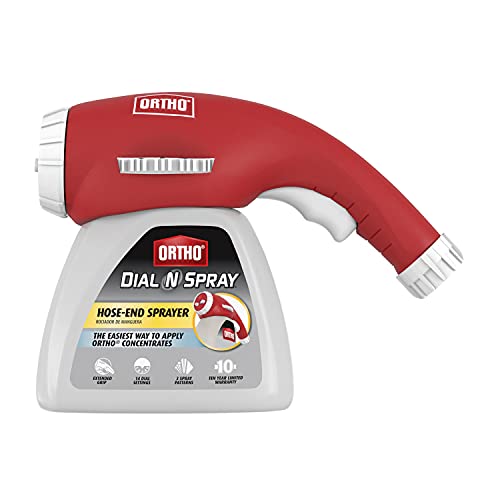
The Dial N Spray suits anyone who already buys Ortho concentrates and wants the mixing done at the dial. Fourteen dilution settings run from 1 teaspoon up to 8 ounces per gallon, covering light fungicide mixes and heavier lawn feeds on one head. An extended-reach grip keeps your hand behind the jar and away from the spray, and the jar’s suction tube draws concentrate up as water passes through. Three spray patterns handle flat lawn passes, directed streams for shrubs and gentler coverage over beds, all from the same trigger.
Specs
- Dilution settings: 14
- Mixing range: 1 teaspoon to 8 ounces per gallon
- Spray patterns: 3
- Grip: extended design to help keep hands dry
- Intended products: liquid weed killer, insect killer, fungicide and fertilizer concentrates
Best for: Owners of Ortho concentrates who want brand-matched settings and a dry hand.
Watch out for: The 14 settings are fixed steps, so a label rate that falls between steps has to be rounded to the nearest one.
ASIN: B0071D0EZK
Chapin G390
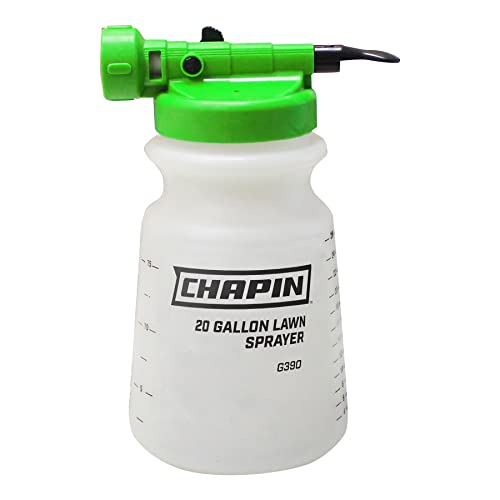
The G390 strips the concept back for one job: putting water-soluble lawn products down fast. Its 32-ounce tank empties into up to 20 gallons of finished spray per fill, and a finger-control valve on the head starts and stops flow without walking back to the faucet. Backflow prevention is built in, and the translucent white tank shows the concentrate level at a glance. Because the design is tuned for water-soluble materials, it fits soluble fertilizers and similar mixes rather than thick liquids, which keeps the whole unit simple and light in the hand.
Specs
- Tank capacity: 32 ounces
- Output: up to 20 gallons of finished spray per fill
- Control: finger control on the head
- Backflow prevention: built in
- Product type: water-soluble materials
Best for: Straightforward lawn feeding with soluble fertilizer on a regular schedule.
Watch out for: It is built around water-soluble materials, so thick or undissolved products belong in a different sprayer.
ASIN: B00UER1SKK
The Andersons Refillable Multipurpose Hose End Sprayer (2-Pack)
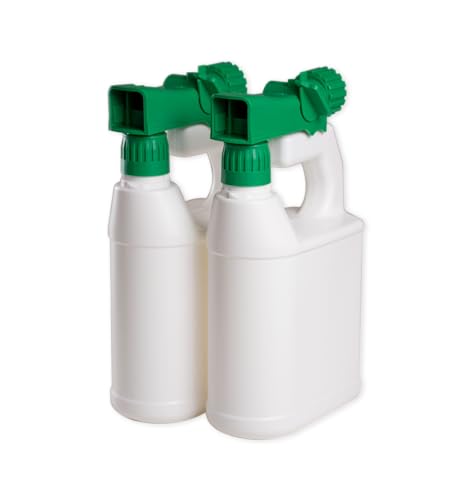
The Andersons two-pack solves a scheduling problem: lawn food can sit ready in one 32-ounce sprayer while an insect treatment waits in the second. Each K1 head mixes at a fixed 20:1 ratio and switches between off, water only and water plus product, so rinsing a bed or the pavement is a quick turn rather than a tool change. There is no dial to set, which makes the pair a speed play for products whose labels match the fixed mix. Both bottles are refillable, lightweight plastic with quick-fill openings.
Specs
- Pack contents: 2 hose end sprayers
- Bottle capacity: 32 ounces each, refillable
- Mixing ratio: fixed 20:1
- Spray head: K1, with off, water only and water plus product modes
Best for: Households that keep a feed and a treatment ready to spray in the same session.
Watch out for: The fixed 20:1 mix cannot follow labels that call for stronger or weaker rates.
ASIN: B07YZQTLYS
RL Flo-Master Chameleon

The Chameleon earns its name by attaching two ways: it screws onto its included 32-ounce refillable bottle, or it fits directly onto many ready-to-use concentrate bottles so the product never gets poured. Its dial sets mix rates from 1 teaspoon to 8 ounces per gallon, and a quick-connect adapter snaps the head onto the hose without threading it each time. Three patterns, fan, shower and stream, cover lawns, beds and targeted shrubs, and an instant on-off trigger keeps the mix where you aim it.
Specs
- Model: 36HE6
- Bottle capacity: 32 ounces, refillable, included
- Mix rates: 1 teaspoon to 8 ounces per gallon, set by dial
- Spray patterns: fan, shower and stream
- Connection: quick-connect hose adapter
- Attachment: fits the included bottle or many concentrate bottles directly
Best for: Gardeners who dislike pouring concentrates and swap attachments at the hose often.
Watch out for: Direct attachment depends on the concentrate bottle’s neck matching the head, so odd-shaped bottles still need the included bottle.
ASIN: B01B174GKA
Which One Fits Your Situation
Feeding a Whole Lawn in One Pass
Coverage per fill decides this job. A dial head mixing a light feed can stretch a single bottle across hundreds of gallons of finished spray, while a 20-gallon-per-fill design means returning to the faucet partway across a large yard. If your lawn routine is one product at one rate all season, either style works; if the rate changes between spring feeding and summer treatments, the dial earns its place.
Treating Beds and Shrubs With Changing Products
Flower beds rarely need the same mix twice in a row. Fungicide one week and insect treatment the next means the dial gets reset constantly, and a wide setting range with a shower pattern protects both the plants and the person spraying. A sprayer that also attaches directly to concentrate bottles saves pouring small amounts back and forth, which is where most spills in a bed-side routine tend to happen.
Keeping Two Treatments Ready at Once
When lawn feeding day and grub treatment day land together, a twin pack removes the wash-out step between products. One sprayer holds each mix, the fixed ratio keeps the routine identical every time, and the water-only mode rinses the hose line and the plants afterward. This setup suits households with a settled product shelf, where the same two concentrates come out month after month.
Small Yards and Occasional Spraying
A compact yard needs control more than capacity. A modest bottle, a trigger that stops flow instantly and a stream pattern for edging along paths will finish most small jobs in minutes. Occasional users should also weigh storage: a sprayer that rinses clean quickly and hangs by the hose is far more likely to be used correctly the few times a season it comes out.
Common Mistakes
- Setting the dial from habit instead of reading the product label each time, even though rates change between brands and formulas.
- Running thick or partly dissolved products through fixed-mix heads, which clog the pickup tube and throw the ratio off.
- Leaving concentrate sitting in the bottle between sessions, where it thickens, separates and stains the tank.
- Skipping the rinse cycle after spraying, so dried residue from one product contaminates the next application.
- Spraying on a windy afternoon, when drift carries the mix onto beds, paths and plants that were never meant to be treated.
Frequently Asked Questions
How does a hose end sprayer mix the concentrate?
Water rushing through the head creates suction that pulls concentrate up from the attached bottle through a pickup tube. The dial or the head’s fixed geometry meters how much concentrate joins the stream, so the mix leaving the nozzle matches the setting. No premixing in a separate tank is needed, and the bottle holds only the undiluted product.
Can I spray powdered products through one?
Only designs listed for water-soluble materials handle powders, and even then the powder must dissolve fully in the bottle first. Undissolved grains clog the pickup tube and make the delivered rate uneven. Thick liquids cause the same problem in fixed-mix heads, so check the sprayer’s stated product type against your concentrate before filling the bottle.
Do I need to premix anything in the bottle?
For liquid concentrates, no. The bottle takes the product straight from its container, and the head does the diluting as you spray. The exception is a soluble powder in a sprayer listed for water-soluble materials, which should be dissolved in the bottle before the head goes on. Either way, the label rate on the product decides the dial setting, not the amount poured in.
How should I clean and store the sprayer after use?
Empty any leftover concentrate back into its original container, then run plain water through the head until the bottle and tube run clear. Work the dial or mode switch through its positions while rinsing so residue does not dry inside the metering parts. Store the sprayer indoors, out of freezing temperatures, with the bottle empty and the trigger released.