Key takeaways
- Compare the 3 best microcentrifuges for biotechnology workflows, from quick PCR spin-downs to high-speed DNA prep, with real specs and ASINs.
A microcentrifuge is the one bench instrument that touches almost every biotechnology workflow, from pulling down a PCR reaction to pelleting DNA after an extraction. The real buying decision is not about brand loyalty. It is about matching maximum g-force, rotor capacity, and speed control to the protocols you actually run, because a fixed-speed spin-down unit cannot replace a variable-speed machine for pelleting steps, and a high-speed unit is wasted on a bench that only needs quick spins.
This guide is for molecular biology researchers, biotech startup teams setting up a first bench, and teaching labs that need reliable small-volume spinning without a full-size centrifuge. Every product below is a genuine microcentrifuge for 1.5 and 2.0 mL tubes, chosen from its name and specifications on its Amazon listing, with a real ASIN for each model.
Quick Picks
As an Amazon Associate we earn from qualifying purchases
| Product | Best for | Key spec from title |
|---|---|---|
| SCILOGEX D1008 EZee Mini Centrifuge | Everyday PCR spin-downs on a shared bench | 7,000 rpm, 8 x 1.5/2.0 mL rotor plus PCR strip rotor |
| Labnet Spectrafuge 24D Digital Microcentrifuge | High-speed DNA and RNA pelleting at 24-tube capacity | 13,300 rpm, 16,300 x g, 24 x 1.5/2.0 mL rotor |
| LACHOI Mini Centrifuge | Adjustable-speed spinning with a digital display on a tight budget | 1,000-10,000 RPM, 5,600 x g RCF, LCD display |
How to Choose
Match maximum g-force to your protocols
Relative centrifugal force, not rpm, decides whether a protocol works. Quick spin-downs that pull droplets off tube walls and caps need only around 2,000 x g, which is why fixed-speed mini centrifuges exist. Pelleting nucleic acids after ethanol precipitation, clearing cell lysates, and spinning down protein precipitates need far more, often 12,000 x g or above. Before buying, list the highest g-force your protocols call for and treat it as a hard floor. A machine that tops out below that number will leave pellets loose and supernatants cloudy, no matter how convenient its size is.
Check rotor capacity and tube mix
Count the tubes you spin in a typical run, not the tubes you own. A rotor that holds eight 1.5 mL tubes is fine for a single researcher running a few PCR reactions, but a team processing a full extraction batch will wait through repeated runs. Also check whether the rotor accepts 0.2 mL PCR tubes or strips, since many molecular biology workflows alternate between microtubes and PCR strips in the same session. A second rotor, or a combination rotor that takes both, saves the fiddly swap in the middle of a protocol and reduces the chance of dropping a rotor on the bench.
Decide between fixed speed and variable speed
Fixed-speed mini centrifuges start when the lid closes and stop when it opens, which is ideal for spin-downs but useless for timed pelleting at a defined force. Variable-speed machines with digital controls let you set rpm or g-force and a timer, so a protocol that calls for ten minutes at a specific force is repeatable from one day to the next. If your work is only quick spins, fixed speed is simpler and has fewer settings to get wrong. If you run extractions, precipitations, or any step where force and time are written into a standard operating procedure, variable speed is not optional.
Weigh safety features and bench footprint
A microcentrifuge spins a metal rotor fast enough to turn an unbalanced load into a violent vibration, so look for a lid interlock that prevents operation with the lid open and a rotor that seats firmly without tools. Always balance tubes in opposite positions with equal volumes, using a water blank when you run a single tube, and never open the lid while the rotor is still turning. Check the footprint and weight too: a compact unit under five pounds can sit beside a thermal cycler, while a heavier digital machine needs a stable, dedicated spot with clear airflow around its vents.
The 3 Best Options
SCILOGEX D1008 EZee Mini Centrifuge
The D1008 is the classic bench-side spin-down machine, built for the short spins that fill a molecular biology day: pulling PCR mix off tube walls, collecting droplets after a vortex step, and quick spins before loading a gel. Its fixed speed keeps operation to a single action, close the lid and it spins, open the lid and it stops, so there is nothing to program between steps. The two included rotors cover both microtubes and PCR strips, which makes it a practical shared-bench tool for small teams and teaching labs where several people use the same instrument.
Specs
- Max speed: 7,000 rpm
- Max RCF: 2,680 x g
- Rotor: 8 x 1.5/2.0 mL microtubes plus PCR strip rotor
- Power: 110/240V with US plug
- Model: 91003141, blue-lid kit
Best for: Researchers and teaching labs that need fast, simple spin-downs of microtubes and PCR strips.
Watch out for: Fixed speed only, so it cannot run timed pelleting steps that need a defined g-force; confirm the 7,000 rpm ceiling covers your protocols before ordering.
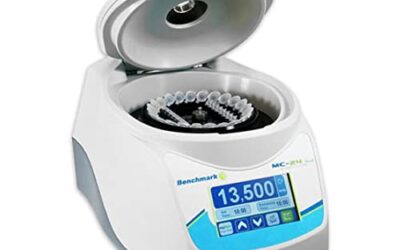
Labnet Spectrafuge 24D Digital Microcentrifuge
The Spectrafuge 24D is the workhorse of this group, a digital microcentrifuge that reaches forces high enough for real pelleting work while holding a full rack of 24 tubes. Its digital controls let you set and view speed in rpm or g-force, and the timer runs from 30 seconds to 30 minutes or continuously, with a quick button for momentary spins. The easy-access aluminum rotor makes loading and unloading a full batch straightforward, and the multi-flow air cooling system keeps the chamber from heating up during longer runs. This is the pick when your workflow regularly includes extractions and precipitations rather than only spin-downs.
Specs
- Speed range: 500 to 13,300 rpm
- Max RCF: 16,300 x g
- Capacity: 24 x 1.5/2.0 mL tubes
- Timer: 30 seconds to 30 minutes, continuous, or momentary
- Electrical: 120V, 60 Hz
- Dimensions: 9.25 x 11.5 x 8.5 inches
- Weight: 18 lb
Best for: Biotech labs running DNA and RNA extractions, precipitations, and lysate clearing at 24-tube scale.
Watch out for: It is a heavier bench instrument at 18 lb, so plan a permanent spot with ventilation; smaller 0.5 mL and 0.2 mL tubes need adapters sold separately.
LACHOI Mini Centrifuge

The LACHOI mini centrifuge fills the gap between a fixed-speed spin-down unit and a full digital microcentrifuge, offering adjustable speed from 1,000 to 10,000 rpm with an LCD display that shows the setting as it runs. That range covers both gentle collection spins and firmer pelleting steps, and the two included rotors handle microtubes from 0.2 mL up to 2.0 mL as well as PCR strips. For a small lab, a startup bench, or a secondary workstation that needs more than a basic spin-down machine without the footprint of a larger unit, this is a flexible and compact option.
Specs
- Speed range: 1,000-10,000 RPM
- Max RCF: 5,600 x g
- Display: LCD display
- Rotors: 8 x 0.2/0.5/1.5/2 mL tubes and 2 x 8 x 0.2 mL PCR strips
- Model: Mini centrifuge for microtubes
Best for: Small labs and secondary benches that need adjustable speed and a digital display in a compact unit.
Watch out for: Its 5,600 x g ceiling sits below the force many nucleic acid pelleting protocols call for, so check your highest-force step first; verify tube adapters are included for the sizes you use most.
Which One Fits Your Situation
You mostly run PCR and need quick spin-downs
Choose the SCILOGEX D1008. Its fixed-speed operation and dual rotors match the rhythm of PCR setup, where the job is collecting liquid from caps and walls between steps. There is nothing to program, so anyone on the bench can use it correctly on the first try, and the PCR strip rotor means you do not need a second machine for strip tubes.
You run extractions and precipitations every day
Choose the Labnet Spectrafuge 24D. Its 16,300 x g maximum and 24-tube rotor are built for pelleting nucleic acids and clearing lysates, and the digital timer and rpm or g-force display make those steps repeatable across runs and across team members. The larger capacity also keeps batch processing to a single spin instead of several.
You need adjustable speed on a small or second bench
Choose the LACHOI Mini Centrifuge. The 1,000-10,000 rpm range and LCD display give you real control over spin force without the size and weight of a full digital microcentrifuge, and the two rotors cover the common tube sizes in one box. It suits a startup bench, a teaching station, or a satellite workstation that supports a main lab.
You share one centrifuge across a team
Choose the Labnet Spectrafuge 24D if the team runs extractions, or the SCILOGEX D1008 if the shared work is mostly spin-downs. Shared instruments get used at the highest force anyone needs, so pick by the most demanding protocol on the bench, not the average one, and keep the manual and a balancing guide posted beside the machine.
Common Mistakes
- Buying a fixed-speed spin-down unit and then discovering your extraction protocol needs 12,000 x g or more to form a solid pellet.
- Loading tubes without balancing them in opposite positions, which causes vibration, excess wear, and in bad cases a rotor failure.
- Opening the lid before the rotor has fully stopped, or running the machine with the lid unlatched on models that allow it.
- Assuming every rotor accepts every tube size; 0.2 mL and 0.5 mL tubes usually need adapters that are sold separately.
- Ignoring biological sample safety: treat samples as potentially infectious, use sealed rotors or safety cups where your protocol calls for them, and decontaminate spills according to your lab biosafety rules before running the next batch.
Frequently Asked Questions
What g-force do I need for DNA pelleting?
Most nucleic acid precipitation protocols call for 12,000 x g or more to form a firm pellet that survives washing steps. A fixed-speed spin-down unit at around 2,000 x g will not pellet DNA reliably. Check the highest g-force in your standard operating procedures first, then choose a microcentrifuge whose maximum exceeds it.
Can a mini centrifuge replace a full-size microcentrifuge?
It depends on the protocol. For quick spin-downs and collecting droplets, a mini centrifuge is exactly the right tool and faster to use. For pelleting, timed spins at a defined force, and large batches, a variable-speed digital microcentrifuge with a larger rotor is the correct choice, since mini units lack both the force and the timer control those steps need.
How do I balance tubes in a microcentrifuge?
Place tubes of equal volume in directly opposite rotor positions so the load is symmetric. If you have an odd number of samples, add a balance tube filled with the same volume of water. Never run a single tube alone, and never mix very different fill levels across from each other, because imbalance causes vibration and wears the drive.
Are microcentrifuges safe for biological samples?
Microcentrifuges are standard equipment for biological samples, but safety depends on practice: balance the load, keep the lid closed while spinning, and follow your lab biosafety rules for the organisms you handle. If a tube breaks inside the rotor, stop the run, let aerosols settle, and decontaminate the rotor and chamber as your biosafety manual directs before reuse.