Key takeaways
- Compare five laboratory microcentrifuges on speed, RCF, rotor capacity and noise, from a 24-place touchscreen model to compact 12-place bench units.
Choosing a microcentrifuge is mostly a decision about force and format. Your protocols set the relative centrifugal force they need, stated in RCF rather than rpm, and your daily sample volume sets the rotor size that keeps batches moving. A unit that tops out below a protocol’s force requirement cannot be fixed by spinning longer, so the headline speed figure matters less than the RCF the installed rotor actually delivers.


This guide is for research laboratories spinning standard 1.5 and 2.0 milliliter microtubes, with or without PCR strip work in the same run. The five picks below run from the Benchmark Scientific MC-24 Touch, a 24-place touchscreen model with a combination rotor, through the high-force D3024, to compact 12-place units from 4E’s USA, ONiLAB and JOANLAB for smaller benches.
Quick Picks
As an Amazon Associate we earn from qualifying purchases
| Product | Best for | Key spec |
|---|---|---|
| Benchmark Scientific MC-24 Touch | Busy molecular biology benches | 13,500 rpm and 16,800 x g with a 24-place COMBI-Rotor |
| D3024 High Speed Micro Centrifuge | Maximum force in a 24-place format | 15,000 rpm and 21,380 x g |
| 4E’s USA High Speed Micro Centrifuge | Compact 12-place high-speed work | 15,000 rpm and 15,100 x g |
| ONiLAB LCD Digital High Speed Mini Centrifuge | Quiet shared benches | 15,100 x g with noise at or below 54 dB |
| JOANLAB MC-12PRO | Mixed microtube and PCR strip runs | 12,000 rpm with a 3-in-1 rotor |
How to Choose
Match RCF to your protocols, not rpm
Protocols state their force requirement as RCF, and the same rpm produces different force in different rotors because force depends on rotor radius. Compare each model’s maximum RCF with the rotor fitted, not the headline rpm. A 15,000 rpm unit with a small rotor can deliver less force than a slower unit with a larger one. The D3024 reaches 21,380 x g, while the JOANLAB MC-12PRO is a 12,000 rpm machine aimed at quicker, lighter separations. List the highest force your current protocols call for, add headroom for future work, and treat that figure as the floor for any model you shortlist.
Pick rotor capacity around your real batch size
Rotor capacity decides how many tubes move through the lab per run. A 24-place rotor, like the one in the MC-24 Touch and the D3024, suits extraction and purification batches where samples arrive in groups. A 12-place rotor fits a single researcher’s daily workflow and keeps the footprint small. Also check which tube formats the supplied rotor accepts: combination rotors take PCR strips alongside microtubes, while fixed rotors may need adapters for 0.5 milliliter and 0.2 milliliter tubes. Adapters are cheap, but a rotor that already covers your formats saves changeover time on every run.
Check the control set and program memory
Shared instruments reward simple, repeatable controls. A clear display that can show speed in rpm or RCF removes conversion errors when different protocols specify different units. Program memory, offered by the MC-24 Touch with its mySpin profiles and by the JOANLAB MC-12PRO, lets each user recall a stored speed and time instead of re-entering settings. Timer range matters too: most of these units run from 30 seconds to 99 minutes or continuously. If your lab runs the same two or three spins all day, stored programs are worth more than a marginal speed advantage.
Weigh noise, footprint and safety features
A microcentrifuge often runs a few feet from where people pipette and write, so published noise figures are worth comparing: the ONiLAB unit is rated at or below 54 dB, and the JOANLAB below 56 dB(A). Footprint matters on crowded benches, where the compact 12-place models earn their place. On safety, look for a lid interlock that keeps the lid locked until the rotor stops, over-speed detection, and a sealed or autoclavable rotor for work where tube leakage is a concern. The D3024 adds a dual door interlock and automatic internal diagnosis to that baseline.
The 5 Best Options
Benchmark Scientific MC-24 Touch
The MC-24 Touch is the full-size option here, built around a 24-place COMBI-Rotor that accepts standard microtubes and PCR strips in the same run without swapping rotors. Its full-color touch screen shows actual speed in rpm or RCF alongside set and remaining time, and the mySpin feature stores up to nine speed and time profiles for one-touch recall. A proprietary airflow system is designed to keep samples cool during extended high-speed runs. For a shared molecular biology bench where several people run the same protocols daily, that combination of capacity, stored programs and strip handling is the most complete package in this group.
Specs
- Model: C2417, 115V, 60 Hz
- Speed range: 200 to 13,500 rpm
- Maximum RCF: 16,800 x g
- Rotor: COMBI-Rotor for 24 x 1.5/2.0 mL tubes and PCR strips
- Display: full-color touch screen with rpm or RCF readout
- Program memory: up to 9 stored profiles with mySpin recall
- Item weight: 14 pounds
Best for: busy shared benches running mixed microtube and PCR strip batches
Watch out for: the largest footprint and weight in this group, so measure the bench space first
ASIN: B07D5KKXK3
D3024 High Speed Micro Centrifuge
The D3024 is the force leader in this lineup, reaching 21,380 x g from a 24-place rotor, which covers the demanding end of plasmid preparation, nucleic acid precipitation and lysate clearing work. Its brushless DC motor is maintenance-free, and the listing highlights a dual door interlock, over-speed detection and automatic internal diagnosis. The aluminum alloy rotor is fully autoclavable, and a multi-flow air cooling design addresses rotor heating during long runs. Speed and time are set on an LCD control panel, with runs from 30 seconds to 99 minutes or continuous operation. Labs that regularly hit force ceilings on lesser machines are the natural audience.
Specs
- Speed range: 200 to 15,000 rpm, in 10 rpm increments
- Maximum RCF: 21,380 x g
- Rotor capacity: 24 microtubes
- Run time: 30 seconds to 99 minutes, or continuous
- Motor: brushless DC
- Safety: dual door interlock, over-speed detection, automatic internal diagnosis
- Dimensions: 364 x 280 x 266 mm
- Weight: 12 kg
Best for: protocols that need force above what 15,000 x g class machines deliver
Watch out for: at 12 kg it is the heaviest pick here, and the control set is a keypad panel rather than a touch screen
ASIN: B0DRPVP2H2
4E’s USA High Speed Micro Centrifuge

This 4E’s USA model, CF0201002, packs full high-speed performance into a 12-tube format. It spins from 500 to 15,000 rpm with a stated speed accuracy of plus or minus 20 rpm, and delivers up to 15,100 x g, which matches the force class of much larger machines. The supplied aluminum alloy rotor takes 0.2, 0.5, 1.5 and 2.0 milliliter tubes across its 12 positions. Timed and continuous operation modes are both supported, along with a pulse function for quick spins. It suits a small lab that needs genuine protocol-level force for extraction and purification work but only processes a dozen tubes at a time.
Specs
- Model: CF0201002
- Speed range: 500 to 15,000 rpm
- Maximum RCF: 15,100 x g
- Speed accuracy: plus or minus 20 rpm
- Rotor capacity: 12 x 0.2/0.5/1.5/2.0 mL tubes
- Rotor material: aluminum alloy with biosafety containment lid
- Run modes: timed, continuous and pulse
Best for: small labs needing 15,100 x g force in a compact 12-place unit
Watch out for: 12 places per run means large batches need several consecutive spins
ASIN: B0CJC34ZFY
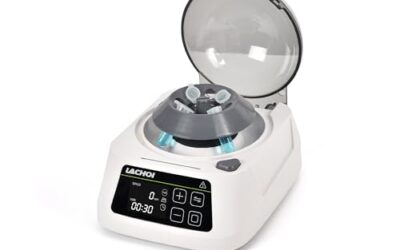
ONiLAB LCD Digital High Speed Mini Centrifuge

ONiLAB’s D2012 Plus class unit is the quiet pick: its listing rates noise at or below 54 dB while still reaching 15,000 rpm and 15,100 x g. The fixed-angle rotor holds 12 tubes across the 0.2 to 2.0 milliliter range with adapters, and speed can be set and displayed in rpm or RCF from the LCD panel. The timer runs from 30 seconds to 99 minutes or continuously, and the wide 100 to 240 volt input suits labs with mixed power setups. Acceleration and braking are brisk on paper, at 11 seconds up and 9 seconds down, which keeps short spin cycles moving.
Specs
- Speed range: 500 to 15,000 rpm, in 100 rpm increments
- Maximum RCF: 15,100 x g
- Rotor capacity: 12 x 0.2/0.5/1.5/2.0 mL tubes
- Run time: 30 seconds to 99 minutes, or continuous
- Noise level: at or below 54 dB
- Display: LCD, switchable between rpm and RCF
- Power: AC 100 to 240V, 50/60 Hz
- Weight: 6 kg
Best for: noise-sensitive shared spaces that still need full high-speed force
Watch out for: the compact housing leaves no room for a 24-place rotor upgrade later
ASIN: B0BW8YB6R1
JOANLAB MC-12PRO
The MC-12PRO is the lightest-duty machine here, and it is honest about its role: quick spin downs and routine separations at up to 12,000 rpm. Its 3-in-1 rotor accepts 12 microtubes of 1.5 or 2.0 milliliters and PCR strip positions without a rotor change, and adapters extend it to 0.2 and 0.5 milliliter tubes. Program memory stores a speed and time setting for repeat runs, and over-temperature protection shuts the unit down and opens the lid if the chamber overheats. An automatic lid lock, a rubber vibration-absorbing base and noise below 56 dB(A) round out a simple, bench-friendly package for teaching and satellite labs.
Specs
- Maximum speed: 12,000 rpm
- Rotor: 3-in-1, 12 x 1.5/2.0 mL positions plus PCR strip positions
- Tube range: 0.2, 0.5, 1.5 and 2.0 mL with included adapters
- Program memory: stored speed and time settings
- Protection: over-temperature shutdown, automatic lid lock
- Noise level: below 56 dB(A)
- Motor: brushless
Best for: teaching labs and satellite benches doing quick spins and light separations
Watch out for: the 12,000 rpm ceiling sits below the force range many extraction protocols specify
ASIN: B09Q2W5N5K
Which One Fits Your Situation
You run extraction batches all day
Choose the D3024 or the MC-24 Touch. Both take 24 tubes per run, which halves the number of spins compared with a 12-place machine. The D3024 adds the highest force in the group at 21,380 x g, while the MC-24 Touch adds stored programs and strip handling. Pick force if your protocols demand it, and pick the touchscreen model if several people share the bench and repeat the same runs.
You have one small bench and a dozen tubes at a time
The 4E’s USA and ONiLAB units both deliver 15,100 x g from a 12-place rotor, so force is not the compromise it often is with compact machines. Take the ONiLAB if the centrifuge will sit near people working, since its listing rates noise at or below 54 dB. Take the 4E’s USA model if the pulse function and aluminum rotor with a containment lid matter more to your workflow.
You spin PCR strips as often as microtubes
The MC-24 Touch and the JOANLAB MC-12PRO both handle strips without a rotor swap, the Benchmark through its COMBI-Rotor and the JOANLAB through its 3-in-1 rotor. Choose by workload: the MC-24 Touch pairs strip handling with 24-place capacity and 16,800 x g, while the MC-12PRO is the smaller, simpler machine for lighter daily volumes where 12,000 rpm is enough.
You are equipping a teaching or training lab
The JOANLAB MC-12PRO fits supervised settings: an automatic lid lock, over-temperature shutdown and stored programs keep operation simple for rotating users, and its lower speed ceiling matches routine demonstrations and sample preparation. If the teaching lab also supports research projects, step up to the ONiLAB instead, which keeps the compact format but raises the ceiling to 15,000 rpm and 15,100 x g.
Common Mistakes
- Comparing models by rpm alone, when RCF is the figure protocols specify and the one that varies with rotor radius.
- Buying a 12-place rotor for a lab whose samples arrive in batches of 24, then losing time to doubled runs every day.
- Ignoring tube format: ordering a fixed microtube rotor when half the workload is PCR strips that need a combination rotor or adapters.
- Overlooking noise ratings for a centrifuge that will run beside a workstation where people concentrate.
- Skipping the safety basics, such as a lid interlock and a sealed or autoclavable rotor, to save a small amount on the purchase.
Frequently Asked Questions
What RCF do most microcentrifuge protocols need?
Many routine molecular biology protocols, such as plasmid minipreps and nucleic acid precipitation, specify forces in the range of roughly 10,000 to 16,000 x g, while some clearing and pelleting steps ask for more. Check your own protocol sheets before buying: the D3024 covers up to 21,380 x g, while the 12,000 rpm JOANLAB suits lighter work below that band.
Can one microcentrifuge handle both microtubes and PCR strips?
Yes, if the rotor is designed for both. Combination rotors, like the COMBI-Rotor on the MC-24 Touch and the 3-in-1 rotor on the JOANLAB MC-12PRO, accept microtubes and PCR strips in the same run. Fixed-angle microtube rotors usually need a separate strip rotor or adapters, so confirm what the supplied rotor accepts before assuming strips are covered.
Does a refrigerated model appear in this guide?
No. All five picks are ambient, non-refrigerated microcentrifuges, because the refrigerated models from these brands are sold through laboratory suppliers rather than confirmed Amazon US listings. If your samples must stay cold during long spins, look at airflow-cooled designs such as the MC-24 Touch for shorter runs, or source a refrigerated unit like the D3024R class through a lab supplier.
How long should a microcentrifuge run for a typical spin down?
A spin down that collects droplets from tube walls takes only a few seconds at moderate speed, which is why several models here include a pulse or short-spin function. Timed protocol runs are longer and are set per the protocol, anywhere from under a minute to half an hour. Every model in this guide times runs from 30 seconds to 99 minutes, with continuous operation available.