Key takeaways
- Microcentrifuges with published timers for academic labs: timed runs up to 99 minutes, speeds to 12,000 RPM, and rotors for microtubes and PCR strips.
Academic protocols live or die on repeatability, and a spin that runs long because someone forgot a tube changes results across a whole teaching cohort. A microcentrifuge with a real, settable timer lets every student run the same timed cycle instead of guessing by lid and stopwatch. The decision is which timer range, speed ceiling, and rotor format match the tubes your lab actually loads each week.

This roundup is for teaching-lab managers, research groups, and prep-room staff who need timed runs for microtubes and PCR strips. Every pick below is a laboratory microcentrifuge whose own Amazon listing publishes a timer or timed-run function, and every specification is taken from that product’s Amazon page name and listing details.
Quick Picks
As an Amazon Associate we earn from qualifying purchases
| Product | Best for | Key spec from title |
|---|---|---|
| LACHOI Lab Mini Centrifuge Machine | Teaching labs running varied timed protocols | Timer 1-99 minutes, 100-12000RPM |
| LAB FISH High Speed Centrifuge | Repeat runs with stored speed and time | 12000 RPM, 9660 x g, 3-in-1 rotor |
| JOANLAB MC-10PRO Micro Centrifuge | Labs mixing microtubes and glass capillary tubes | 10000RPM, 6708xg, timer |
| VEVIVOOVY Digital Centrifuge Machine | Short, precisely timed spins under a minute | Timing range 30s-59min50s |
How to Choose
Timer range and how the timed cycle is set
Start with the run lengths your protocols actually use. Most microtube pelleting steps in academic labs sit between thirty seconds and ten minutes, so a timer that starts below one minute matters as much as a long maximum. The VEVIVOOVY listing publishes a timing range of 30s-59min50s, which covers quick spin-downs and longer separations in one dial. The LACHOI listing instead sets run time from 1 to 99 minutes on its LCD screen, suiting protocols that run longer but never need sub-minute precision. Check whether the timer is digital or a memory-backed program, because a stored timed cycle is easier to hand to a class than a knob position.
Speed range and maximum RCF for your protocols
Match the published speed range and maximum RCF to the hardest step in your protocol book, not the easiest. DNA and RNA precipitation steps typically need far more force than a simple spin-down of droplets. The LAB FISH and VEVIVOOVY listings both publish a maximum of 9660 x g at 12000 RPM, while the JOANLAB MC-10PRO publishes 6708xg at 10000RPM and the LACHOI publishes 7245 x g across a wider 100-12000 RPM range. A wide low end also matters: gentle speeds keep fragile pellets intact during wash steps. Read the listing’s own figures rather than assuming two machines with the same top speed deliver the same force.
Rotor format: microtubes, PCR strips, or capillary tubes
Rotor format decides whether one machine can serve a whole bench. The LAB FISH listing describes a 3-in-1 rotor that accepts 0.2, 0.5, 1.5, and 2 ml microcentrifuge tubes without swapping rotors, which suits mixed teaching work. The LACHOI listing instead bundles two rotors, an 8-place round rotor and a 16-place strip rotor for PCR work. The JOANLAB and VEVIVOOVY listings add a 12-position rotor for 40 mm glass capillary tubes alongside microtube adapters, a format hematocrit-style exercises need. Count the positions as well as the sizes: an 8-place rotor means more repeat runs for a class of twenty-four students.
Safety behavior and limits on timed runs
A timer is only useful if the machine behaves predictably around students. Look for what the listing says about the lid: the LACHOI listing publishes automatic stop when the lid opens and resume when it closes, while the LAB FISH listing publishes an open-lid brake system plus overheat protection that stops the run automatically. Respect published duty limits, too. The LACHOI listing warns against running continuously for more than 30 minutes even though its timer reaches 99 minutes, so long timed cycles should be split or supervised. Published noise figures, such as the 47 dB(A) in the VEVIVOOVY listing, also matter in quiet prep rooms.
The 4 Best Options
LACHOI Lab Mini Centrifuge Machine
For a teaching laboratory that runs several different timed protocols in one afternoon, this LACHOI model offers the broadest timing window in the group. Its listing sets run time anywhere from 1 to 99 minutes on a clear LCD screen, paired with an unusually wide 100-12000 RPM speed range, so one bench unit can cover gentle wash spins and firm pelleting steps. The two-rotor bundle handles both loose microtubes and PCR strips, and the automatic stop-on-lid-open behavior suits supervised student benches where lids get lifted mid-cycle more often than instructors would like.
Specs
- Speed range: 100-12,000 RPM
- Maximum RCF: 7245 x g
- Timer: run time settable from 1 to 99 minutes on the LCD screen
- Rotors: 8-place round rotor for 0.2/0.5/1.5/2.0 ml tubes and 16-place strip rotor for 2x8x0.2 mL PCR strips
- Power supply: 100-240V
- Dimensions: 6.7 x 5.7 x 4.7 inches
- Motor: maintenance-free brushless DC motor
- Safety: automatic stop when the lid opens, resumes when the lid closes
Best for: Teaching labs that need one compact unit to cover timed runs from a minute up to 99 minutes across microtubes and PCR strips.
Watch out for: The listing warns the machine should not be used continuously for more than 30 minutes, so plan long protocols as supervised, separated cycles.
ASIN: B0G3PC7MP9
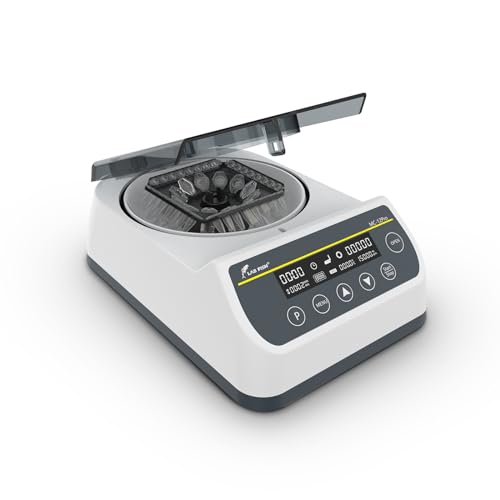
LAB FISH High Speed Centrifuge
Research groups that repeat the same extraction protocol daily will appreciate the memory mode in this LAB FISH listing, which records the required speed and time so the next run starts without re-entering parameters. That makes timed cycles consistent across different operators, a real concern in shared academic facilities. The listing publishes the joint-highest force in this group, 9660 x g from a brushless motor with PWM speed control across 1000-12000 rpm, and its 3-in-1 rotor takes four microtube sizes without a rotor change, keeping a busy bench moving between sample types.
Specs
- Speed control: 1000-12000 rpm with PWM wide-range electronic control
- Maximum RCF: 9660 x g
- Motor: brushless motor
- Rotor: 3-in-1 rotor for 0.2/0.5/1.5/2 ml microcentrifuge tubes, no rotor replacement needed
- Timer: memory mode records the required speed and time for repeat timed runs
- Safety: overheat protection with automatic stop, low-voltage power input, open-lid brake system, rotor snap design
- Warranty: 1 year limited warranty stated in the listing
Best for: Research benches repeating the same timed extraction cycles, where stored speed and time settings keep results consistent between users.
Watch out for: The listing describes timed runs through its memory program rather than a printed minute range, so confirm the exact timer span on the product page before ordering for very long protocols.
ASIN: B0D7VSGNWL
JOANLAB MC-10PRO Micro Centrifuge

The JOANLAB MC-10PRO is the pick for laboratories whose timed work spans both plastic microtubes and small glass capillary tubes. Its listing names a timer in the product title itself and pairs a digital display with a memory mode for frequently used protocols, so a standard ten-minute timed cycle can be recalled instead of reset. Power comes from a brushless motor with PWM control across 1000-10000 RPM, reaching 6708xg, and the dual-rotor system covers a 12-position micro rotor for 40 mm glass tubes plus a universal adapter rotor for standard microcentrifuge tube sizes.
Specs
- Speed range: 1000-10000 RPM with PWM speed control
- Maximum RCF: 6708xg
- Motor: high-speed brushless motor
- Timer: digital timing function named in the listing title, with memory mode to save frequently used protocols
- Rotors: 12-position micro rotor for 40 mm glass tubes and universal adapter rotor for 0.2/0.5/1.5/2 ml microcentrifuge tubes
- Display: digital display
Best for: Academic labs that combine microtube work with capillary-tube exercises and want a named timer with protocol memory.
Watch out for: Its 6708xg ceiling is the lowest in this group, so check your hardest pelleting protocol against that figure before choosing it.
ASIN: B0DCHVXWP9
VEVIVOOVY Digital Centrifuge Machine

Where the academic task is a short, exact spin rather than a long separation, this VEVIVOOVY machine publishes the most granular timing in the group: a timing range of 30s-59min50s, so a forty-second timed cycle is a setting rather than an estimate. The listing pairs that timer with the joint-highest force here, 9660xg across a 10000-12000rpm range, and adds over-temperature protection that suits unattended timed runs in a prep room. Its rotor set is built around 40 mm glass capillary tubes while the title also covers 0.2, 0.5, 1.5, and 2 ml tubes, and the published noise figure is a quiet 47 dB(A).
Specs
- Speed range: 10000-12000rpm, plus or minus 5 percent
- Maximum RCF: 9660xg
- Timing range: 30s-59min50s
- Capacity: 12 tubes x 40 mm glass capillary tubes, 1.5 mm diameter
- Tube sizes named in the title: 0.2/0.5/1.5/2 ml
- Power: AC 100-240V, DC 24V input, 45W
- Noise level: 47 dB(A)
- Protection: over-temperature protection
Best for: Labs whose timed cycles are short and precise, especially capillary-tube work that needs settings below one minute.
Watch out for: The speed range starts at 10000rpm with no gentle low end, so it is a poor fit for protocols that need slow, soft spins.
ASIN: B0F316Z62C
Which One Fits Your Situation
A teaching lab running back-to-back class sections
Choose the LACHOI. Its 1 to 99 minute timer, two bundled rotors, and stop-on-lid-open behavior match a room where different groups load microtubes and PCR strips all day. The wide speed range means one model can be standardized across sections instead of buying different machines per course.
A research group repeating one extraction protocol
Choose the LAB FISH High Speed Centrifuge. The memory mode stores the speed and time your protocol needs, so every operator runs the identical timed cycle, and the 9660 x g ceiling covers demanding pelleting steps. Its 3-in-1 rotor also removes rotor swaps between the tube sizes a single workflow uses.
A lab that also runs capillary-tube exercises
Choose the JOANLAB MC-10PRO if microtubes dominate and capillary tubes are occasional, thanks to its dual-rotor system and protocol memory. Choose the VEVIVOOVY instead when capillary work is the main task and your timed cycles are short, because its published timing starts at thirty seconds and its rotor set is built around 40 mm glass tubes.
A small prep room where noise and supervision matter
Choose the VEVIVOOVY for its published 47 dB(A) noise figure and over-temperature protection during timed runs, or the LACHOI if staff need the lid to stop the rotor automatically when opened. Either way, match the published duty guidance to how long the room leaves machines running between classes.
Common Mistakes
- Buying a mini centrifuge with no published timer and assuming a stopwatch routine is close enough for graded lab work.
- Comparing top speed alone and ignoring maximum RCF, which is the figure your pelleting protocol actually specifies.
- Setting a 99-minute timed cycle on a machine whose listing warns against more than 30 minutes of continuous running.
- Loading tubes asymmetrically to save time; listings for these machines instruct balanced, symmetrical loading to prevent damage.
- Mixing rotor formats in one purchase and discovering the bundled rotor takes PCR strips but not the capillary tubes your course uses.
Frequently Asked Questions
Why does a timed cycle matter for academic lab results?
Protocols specify spin duration because pelleting and separation keep changing while the rotor turns. A published timer makes every student run the same duration, so results stay comparable across a class or a research team. Without one, run length depends on whoever is watching the clock, and small timing differences become unexplained variation in the data.
Can these microcentrifuges run PCR strips as well as loose tubes?
Two of the four can, based on their listings. The LACHOI bundles a 16-place strip rotor alongside its round rotor, and the LAB FISH 3-in-1 rotor accepts 0.2 ml tubes used in strip formats. The JOANLAB and VEVIVOOVY listings center on microtubes and 40 mm glass capillary tubes instead, so check the rotor description against your consumables before ordering.
What timer range should a teaching laboratory look for?
Cover the shortest and longest steps in your protocol book. Quick spin-downs need settings under one minute, which the VEVIVOOVY listing publishes from thirty seconds, while longer separations benefit from the LACHOI listing’s 99-minute maximum. A memory mode, offered in the LAB FISH and JOANLAB listings, helps when the same timed cycle repeats every session.
Are 15 ml benchtop centrifuges a substitute for these models?
No. Larger benchtop centrifuges are built around 15 ml and bigger tubes and usually deliver far lower RCF at the microtube scale. These four listings are microcentrifuges sized for 0.2 to 2 ml tubes and, on two models, capillary tubes. Buying by tube format first, then timer range, avoids ending up with a machine your consumables do not fit.