Key takeaways
- Compare 5 microcentrifuges with timed cycles for research labs: speeds to 15,000 rpm, 12- and 24-place rotors, timers to 9 hours 59 minutes.
A timed cycle is the difference between a repeatable protocol and a guess. In a research laboratory, spin time decides whether a pellet forms cleanly, whether nucleic acid stays intact, and whether the next step starts on schedule, so the timer, not top speed alone, is the specification that shapes daily work. The five microcentrifuges below all set run time on a digital control and stop on their own, which frees a researcher to prepare the next samples instead of watching a rotor.


This guide covers personal 12-place units for single benches, 24-place workhorses for shared molecular biology benches, and one refrigerated model for temperature-sensitive spins. Every pick is a true microcentrifuge for 1.5 and 2.0 mL tubes, every speed and timer figure comes from the manufacturer’s listing, and each model is listed on Amazon US under the ASIN shown with it.
Quick Picks
As an Amazon Associate we earn from qualifying purchases.
| Product | Best for | Key spec from title |
|---|---|---|
| Scilogex SCI-24 (D3024) | Shared molecular biology benches running full 24-tube batches | 15,000 rpm, 24-place rotor, 30 s–99 min timer |
| Eppendorf 5424 | High-throughput DNA and RNA prep with long timed runs | 15,000 rpm, 24-place rotor, 30 s–9 h 59 min timer |
| Eppendorf 5424 R | Temperature-sensitive samples that need cooling during the spin | 15,000 rpm, refrigerated, 30 s–9 h 59 min timer |
| Eppendorf MiniSpin Plus | A personal centrifuge at a single workstation | 14,500 rpm, 12-place rotor, 15 s–99 min timer |
| Thermo Scientific Heraeus Pico 17 | Routine daily spins on a crowded bench | 13,300 rpm, 24-place rotor, 1–99 min timer |
How to Choose
Match the timer range to your longest protocol
A timer that tops out at 30 minutes will cut short an overnight-style pelleting step or a long column wash, while a timer that stretches to 9 hours 59 minutes covers nearly any molecular biology protocol a research lab runs. Short spins need the opposite end of the range: a timer that starts at 15 or 30 seconds handles quick spin-downs without forcing a full minute. Before ordering, list the longest and shortest timed runs your protocols actually call for, then check both ends of the range on the listing. Continuous or hold mode is a useful extra for open-ended steps, but it should never replace a set timer on a protocol that must stop at a defined time.
Check top speed in RCF, not only in rpm
Two microcentrifuges can share a 15,000 rpm headline and still deliver different force, because relative centrifugal force depends on rotor radius as well as speed. Protocols written in ×g are the safer reference: a model rated at 21,380 ×g will pellet material that a 17,000 ×g model leaves in suspension at the same nominal speed. When a protocol specifies force, compare the maximum RCF figures in this guide and confirm the rotor supplied with the unit, since some models reach their headline RCF only with a particular rotor. Buying on rpm alone is the most common way a lab ends up with a centrifuge that cannot run its own standard operating procedures.
Count places, then count your real batches
A 24-place rotor looks generous until a lab runs two protocols at once, and a 12-place rotor looks small until it sits on a bench where one researcher spins six tubes at a time. Map the rotor to the batch, not to the catalogue: count the tubes in your largest routine run, add the adapters you need for 0.2 and 0.5 mL tubes, and leave two spare places for a balance tube. Adapters for smaller tubes are often sold separately, so a rotor that accepts 1.5 and 2.0 mL tubes directly still needs a check for PCR strips. A personal 12-place unit suits a single workstation; a shared bench almost always wants 24 places.
Decide whether refrigeration earns its bench space
A refrigerated microcentrifuge holds samples near 4°C through long, fast spins, which matters for RNA work, enzymes, and anything that degrades as the rotor warms. The trade is real: the refrigerated unit in this guide is the heaviest and deepest of the five, draws more power, and needs clearance around its vents. For DNA pelleting, plasmid minipreps, and routine spin-downs at ambient temperature, an air-cooled model keeps samples close to ambient and costs less bench space. Choose refrigeration when a protocol names a temperature, not because cooling sounds safer in general.
The 5 Best Options
Scilogex SCI-24 (D3024)
The SCI-24, sold as the D3024, is the straightforward choice for a shared bench that runs full batches of microtubes all day. Its timer runs from 30 seconds to 99 minutes with a continuous option, its brushless motor holds speed with little vibration, and the autoclavable aluminum rotor with a bio-safe lid fits the containment habits of a molecular biology lab. The LCD shows speed, time, and temperature together, and a pulse key handles quick spins without disturbing the set program. For a lab that needs 24 places and a timer it can trust, this is the least complicated way to get both.
Specs
- Max speed: 15,000 rpm (300–15,000 rpm)
- Max RCF: 21,380 × g
- Capacity: 24 × 1.5/2.0 mL tubes
- Timer: 30 seconds to 99 minutes, or continuous operation
- Motor: brushless DC motor
- Power: single-phase, 110V/60Hz
Best for: shared molecular biology benches running full 24-tube batches on timed protocols.
Watch out for: no refrigeration, so temperature-sensitive spins need a cold room or a refrigerated model; adapters for 0.2 and 0.5 mL tubes are separate items.
Eppendorf 5424
The 5424 earns its place as the long-run specialist of this group, with a timer that stretches from 30 seconds to 9 hours 59 minutes plus a hold setting for open-ended work. That range covers everything from a ten-second spin-down to an extended pelleting step without a second device, and the aerosol-tight rotor keeps samples contained through the run. Its quiet OptiBowl design and fast acceleration suit a bench where the centrifuge runs beside people doing fine pipetting work. Four rotor options exist for this platform, so the 24-place configuration is the one to confirm on the listing before ordering.
Specs
- Max speed: 15,000 rpm (100–15,000 rpm)
- Max RCF: 21,130 × g
- Capacity: 24 × 1.5/2.0 mL tubes
- Timer: 30 seconds to 9 hours 59 minutes, with hold
- Rotor: 24-place aerosol-tight rotor
- Power: 120V, 50/60Hz
Best for: high-throughput DNA and RNA preparation where timed runs stretch well past an hour.
Watch out for: no refrigeration, so long fast runs will warm toward ambient; confirm the listing ships the 24-place rotor and whether it uses keypad or rotary-knob control.
Eppendorf 5424 R

The 5424 R takes the same 24-place platform as the 5424 and adds a compressor-driven cooling system, which makes it the pick for any protocol that names a temperature. Its range runs from −10°C to 40°C, and the FastTemp function brings the chamber from 21°C to 4°C in about eight minutes, so a cold spin does not need a long pre-cooling wait. The timer matches the non-refrigerated model, stretching to 9 hours 59 minutes with a hold option, and four rotor types fit the platform. For RNA work, enzyme preparations, and temperature-sensitive separations, this is the only model here that controls temperature through the whole run.
Specs
- Max speed: 15,000 rpm
- Max RCF: 21,130 × g
- Capacity: 24 × 1.5/2.0 mL tubes
- Timer: 30 seconds to 9 hours 59 minutes, with hold
- Temperature range: −10°C to 40°C
- FastTemp pre-cooling: 21°C to 4°C in about 8 minutes
Best for: temperature-sensitive samples, RNA work, and enzyme preparations that need cooling during timed spins.
Watch out for: the heaviest and deepest unit in this guide, so measure bench depth and vent clearance first; confirm which rotor is included, since the platform supports four rotor types.
Eppendorf MiniSpin Plus
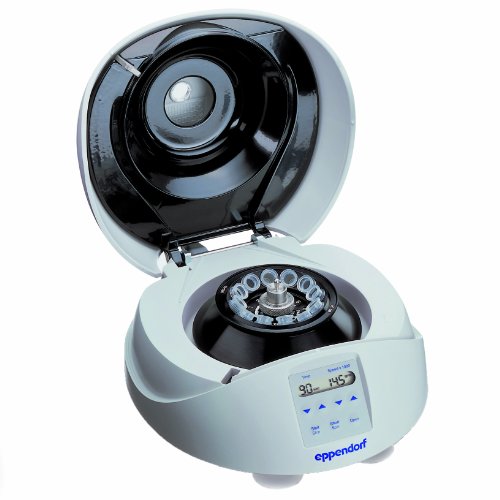
The MiniSpin Plus is a personal microcentrifuge: small enough for one workstation, fast enough for molecular biology separations, and fitted with a timer that runs from 15 seconds to 99 minutes with continuous operation. Its 12-place Black Line aluminum rotor is autoclavable, the lid opens automatically at the end of a run to limit sample warming, and a separate short-spin key handles quick droplet spin-downs. Acceleration and braking each take under 13 seconds, so short protocols do not lose their time advantage to ramp-up. This is the model for a researcher who wants a centrifuge within arm’s reach rather than a shared walk to the equipment room.
Specs
- Max speed: 14,500 rpm (800–14,500 rpm)
- Max RCF: 14,100 × g
- Capacity: 12 × 1.5/2.0 mL tubes
- Timer: 15 seconds to 99 minutes, with continuous run function
- Rotor: 12-place autoclavable aluminum rotor
- Power: 120V, 50–60 Hz
Best for: a single workstation where one researcher runs small timed batches throughout the day.
Watch out for: only 12 places, so it cannot absorb a shared bench’s full batches; verify the listing is the 120V US model (022620207) rather than the 230V version.
Thermo Scientific Heraeus Pico 17

The Pico 17 is built for routine work: a ventilated 24-place microcentrifuge with a 1-to-99-minute timer plus hold, a top speed of 13,300 rpm, and a compact footprint that fits benches where a larger unit would crowd out pipette stands. Its ClickSeal biocontainment lid and choice of seven optional rotors make it easy to adapt to mini-preps, spin columns, and hematocrit work. The trade-off is force: at 17,000 × g it sits below the 15,000 rpm models in this guide, so protocols written for 20,000 × g or more will need a different unit. For everyday timed spins at moderate force, it is the most space-efficient 24-place option.
Specs
- Max speed: 13,300 rpm (800–13,300 rpm)
- Max RCF: 17,000 × g
- Capacity: 24 × 1.5/2.0 mL tubes
- Run time: 1 to 99 minutes (1-minute increments); HOLD
- Power: 120V, 60 Hz
- Rotor: 24-place rotor with ClickSeal biocontainment lid (configuration varies by listing)
Best for: routine daily timed spins on a crowded bench where space matters more than maximum force.
Watch out for: lower maximum RCF than the 15,000 rpm models, so check protocol force requirements first; the included rotor varies by listing, so confirm it is the 24-place rotor and not the hematocrit rotor.
Which One Fits Your Situation
A shared bench running full molecular biology batches
Choose the Scilogex SCI-24 (D3024). Its 24-place rotor matches a full batch, its 30-second-to-99-minute timer covers the standard DNA and RNA protocols, and its 21,380 × g ceiling handles the pelleting steps that define molecular biology work. The autoclavable bio-safe rotor also fits shared-lab hygiene routines better than an open rotor design.
Protocols that run for hours, not minutes
Choose the Eppendorf 5424. Its timer reaches 9 hours 59 minutes with a hold option, which no other non-refrigerated model here matches, and the aerosol-tight rotor keeps long runs contained. Pair it with the 5424 R only if those long runs also need a set temperature, since the 5424 itself has no cooling.
RNA, enzymes, or anything that must stay cold
Choose the Eppendorf 5424 R. It is the only model in this guide with active refrigeration, holding −10°C to 40°C through the spin, and its FastTemp pre-cooling reaches 4°C in about eight minutes. The same long timer as the 5424 means cold protocols are not cut short by the clock.
One researcher, one bench, small batches
Choose the Eppendorf MiniSpin Plus. Its 12-place rotor and compact footprint suit a single workstation, its timer starts at 15 seconds for quick spin-downs, and the automatic lid opening at the end of a run limits sample warming between steps. It is the lightest-touch way to put a timed microcentrifuge within arm’s reach.
Common Mistakes
- Buying on rpm alone and discovering the protocol’s ×g requirement is out of reach with the supplied rotor.
- Choosing a timer that tops out at 30 minutes for protocols that run for an hour or more.
- Ordering a 12-place personal unit for a shared bench, then queueing full batches through it all day.
- Assuming a refrigerated model is always better, when the protocol never names a temperature and the extra size and power draw only crowd the bench.
- Forgetting adapters for 0.2 and 0.5 mL tubes and PCR strips, which are often sold separately from the main rotor.
Frequently Asked Questions
What timer range does a research microcentrifuge need?
It depends on the protocol, but a useful range starts at 15 to 30 seconds for spin-downs and reaches at least 99 minutes for standard molecular biology steps. Labs that run extended pelleting or column washes should look for a timer that reaches several hours, such as the 9-hour-59-minute range on the Eppendorf 5424 models in this guide.
Is a refrigerated microcentrifuge necessary for DNA work?
Usually not. Standard DNA pelleting and plasmid preparation run well on an air-cooled model that keeps samples near ambient temperature. Refrigeration becomes necessary when the protocol names a temperature, most often for RNA work, enzyme preparations, or temperature-sensitive separations that degrade as the rotor warms.
Can one microcentrifuge handle both 1.5 mL tubes and PCR strips?
Many can, but only with the right rotor or adapters. The models here ship with rotors for 1.5 and 2.0 mL tubes, and PCR strip rotors or adapters for 0.2 mL tubes are usually separate purchases. Confirm the included rotor on the listing before ordering, since rotor configurations vary between listings of the same model.
How do I choose between a 12-place and a 24-place rotor?
Count the tubes in your largest routine run and add two places for a balance tube. A 12-place rotor suits a single researcher running small batches at one workstation, while a shared bench running full molecular biology batches will queue work through a 12-place unit. When in doubt, the 24-place rotor is the safer choice for shared use.